




In this article
Microsoft is entering a strange phase in terms of market perception. Even though it is one of the companies with the greatest structural monetization capacity within the artificial intelligence cycle, the market has begun to treat it as if the increase in CAPEX committed for 2026 were a problem of profit erosion rather than a defensive investment to maintain leadership in infrastructure and computing capacity.
MSFT Price
$414
Closing: May 8, 2026
From highs
–25%
Max. $555 Jul-25
Azure Q3 FY26
+40%
fixed exchange rate
IA run rate
$37B
+1,231 TP3T year-over-year
Investment thesis
The problem is that much of the current narrative is centered on the short term. The immediate impact of CAPEX on operational efficiency is being assessed, but not its potential Microsoft to capture a disproportionate share of the economic benefits resulting from the widespread adoption of AI over the next three to five years. And that's probably where the inefficiency. Because when a company of that scale, with that level of vertical integration and that position in enterprise software, begins to aggressively reinvest capital, it usually does so not to weather the next quarter, but to consolidate structural dominance in the next decade.
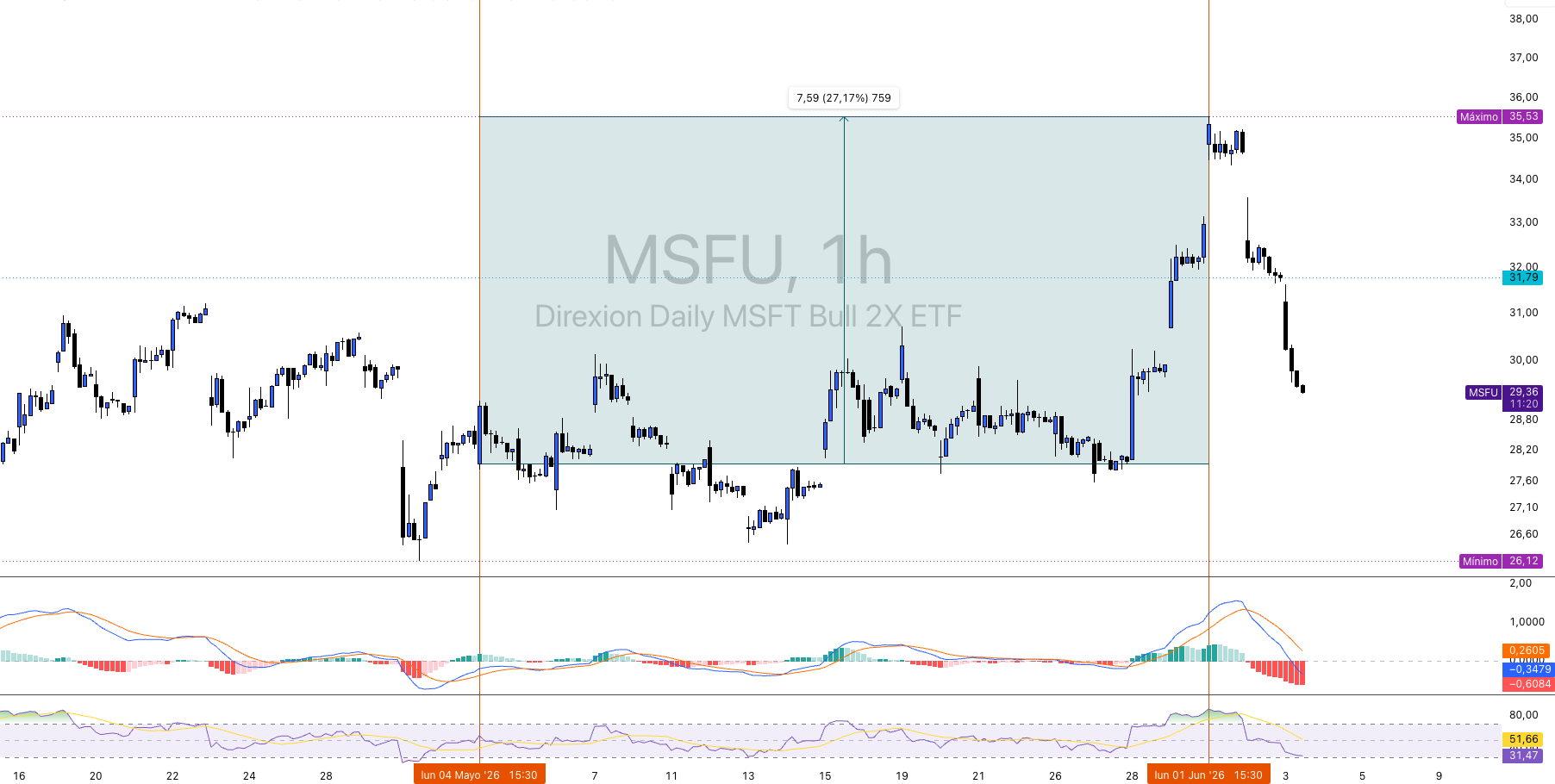
The correction close to 25% since the highs of July 2025, when Microsoft's stock price rose above $555, has pushed the price into a range that, in my opinion, does not adequately reflect the shift currently taking place in the monetization of artificial intelligence on what is likely the most robust and best-positioned cloud infrastructure on the market. At the close of the May 8, 2026, MSFT is trading around ~$415, while the leveraged ETF Direxion Daily MSFT Bull 2X Shares (MSFU) trades at around ~$28.
The thesis is relatively straightforward: Azure continues to accelerate, the M365 Copilot seats have already surpassed 20 million growing at a year-over-year rate of 250%, and Microsoft's AI business has reached a annualized revenue of ~1Q4Q37.000M, growing by 123% in just twelve months. In just four quarters, the actual monetization of AI has gone from being an aspirational narrative to becoming a verifiable, scalable revenue stream with tangible operational traction.
The market, however, reacted by selling off the stock after the results of the Q3 FY2026 published on April 29, primarily due to the psychological impact of the guidance from CAPEX of ~1.4 trillion committed for fiscal year 2026. And that is where, in my view, the inefficiency lies. The market is pricing in the spending, but it is not yet giving sufficient credit to the return that this same expenditure is already beginning to generate.
That is why I have built a position on MSFT, and is not limited solely to directional exposure via equity. The structure of the operation has two deliberately differentiated layers: on the one hand, a direct position in Microsoft, and on the other, a long exposure via call options on the Direxion 2x leveraged ETF linked to MSFT's daily price movements, using calls strike 30 due October. Furthermore, the maximum loss remains defined and limited to the premium paid in the options.
The macroeconomic context complements the core argument quite well. Large enterprise customers continue to renew their M365 contracts by integrating Copilot into their operational stack, which structurally increases ARPU per seat. At the same time, the current analyst consensus 51 purchase recommendations on 54 active hedges, with an average target price of around ~$520. The difference between that consensus and the current price of around ~$414 is, precisely, the safety margin on which I build the thesis.
Valuation Scenarios
The three scenarios are based on a normalized forward P/E ratio applied to the 12-month forward EPS projections for FY2027 as estimated by consensus models.
Pessimistic
$320-$360
–13% to –23%
Azure's growth slows to 28–30%. The market is reinterpreting CAPEX as structural pressure on margins and FCF.
Home
$460-$510
+11% to +23%
Azure maintains 35–38%. Copilot is making progress on enterprise renewals. CAPEX remains stable without any deterioration in FCF.
Optimistic
$550-$620
+33% to +50%
Azure is accelerating growth to 43–45x TP3T. Copilot has surpassed 20 million paid seats. Re-rating to 36–38x EV/EBITDA.
Interactive tool
Payoff Simulator — $MSFT · MSFU · CALL $30 Oct-26
Enter your target price for Microsoft and calculate the return for each component of the strategy in real time: a direct position in MSFT, the 2x leveraged MSFU ETF, and a CALL option with a strike price of $30 expiring in October 2026.
MSFT Live
0.0%
without leverage
MSFU 2x
0.0%
Direxion Leveraged ETF
CALL $30 Oct-26
–100%
premium of $3.70 per share
Comparative return based on MSFT's price at maturity
Note about the model: The return on MSFU is calculated as twice the linear movement of MSFT from $414. In practice, MSFU is rebalanced daily and volatility decay: Over a period of weeks or months, the actual return may be lower than the theoretical 2×, especially in sideways or highly volatile markets. This simulator is for illustrative purposes only and does not constitute financial advice.
Company Analysis
Microsoft By 2026, it will no longer be just the company behind Windows and Office that dominated the PC era for decades. What Satya Nadella has built over the past ten years is, in essence, a vertically integrated technology infrastructure platform, with three deeply interconnected business layers whose architecture is extraordinarily difficult to replicate. Most importantly, this competitive advantage does not appear to weaken with increased CAPEX—in fact, quite the opposite is true: it is reinforced with every investment cycle in data centers, energy capacity, and GPUs.
The business currently revolves around three main segments:
Intelligent Cloud
~$34,700M +30% year-over-year
Azure is accelerating toward growth rates of nearly 40% on a constant-currency basis. It is the main driver of the company's growth.
Productivity & Business Processes
~$29,900M +10% YoY
Copilot is already having a tangible impact on M365 Commercial’s ARPU and on the growth of enterprise sales.
More Personal Computing
~$13,600M +31% YoY
Segments facing the greatest structural pressure: Xbox –5%, Windows OEM –2%. Activision Blizzard brings a user base and a long-term IP portfolio.
Microsoft Azure It currently holds an approximate 22–23% share of the global cloud infrastructure market, compared to Amazon Web Services’ 30–31% and Google Cloud’s roughly 12%. What matters is not just the current market share, but the speed at which Microsoft has been closing the competitive gap with AWS—approximately ten points in just five years. Microsoft already controls the entry point to enterprise IT spending through licensing, productivity, and enterprise software, so much of the upsell to Azure takes place within the same sales stack and by the same sales team.
The restructured agreement with OpenAI, announced on April 27, further reinforces this trend. OpenAI is now establishing itself as one of the largest compute customers within the Azure ecosystem, with that usage directly contributing to the annualized run rate of ~$37 billion associated with the artificial intelligence business. And that partially changes the nature of the thesis: it is no longer just a bet on the future adoption of AI, but on an infrastructure that is beginning to monetize real, recurring and measurable demand at hyperscaler scale.
Fundamental analysis
| Metrics | Value | YoY Change | Comment |
|---|---|---|---|
| Total revenue (Q3 FY2026) | $82.9B | +18% | Beat consensus $81.5B |
| Intelligent Cloud | $34.7B | +30% | Main growth driver |
| Azure (c.c. growth) | 40% | +9pp | vs. 31% in Q3 FY2025 |
| Productivity & Biz Proc. | $29.9B | +10% | Copilot begins to move ARPU |
| More Personal Computing | $13.6B | +3% | Xbox -5%, Windows OEM -2% |
| EPS (adjusted) | $4.27 | +21% | Beat consensus $4.06 |
| Operating margin | 46.3% | +0.2pp | Above guidance 46.1% |
| AI revenue run rate | $37B annualized. | +123% | 20M+ Copilot paid seats |
| CapEx Q3 | $31.9B | –$3.4B vs. est. | Below consensus |
| Guidance revenue Q4 | $86.7-87.8B | +13-15% | Azure 39-40% c.c. guided |
The Q3 FY2026 results ultimately confirmed something that, in my opinion, the market has not yet fully processed: the Azure's long-term growth momentum remains intact and has reversed the narrative of a multi-quarter slowdown that much of the consensus had begun to price in during 2025. Azure went from growing 31% YoY in Q3 FY2025 to 40% YoY in Q3 FY2026, with guidance for Q4 in the range of 39–40%, clearly above the ~37% expected by StreetAccount.
Margins also do not reflect any significant deterioration in operating performance, despite the aggressive investment cycle. The operating margin of 46.3% In Q3, the figure actually exceeded the company's own guidance (46.11 billion in Q3), while CAPEX of approximately 31.9 billion in Q4 came in roughly 3.4 billion below consensus estimates.
The real fundamental risk lies not so much in the size of the CAPEX, but in the speed at which that CAPEX manages to turn into Recognized revenue and monetizable capacity. A company that has been operating for several consecutive quarters under a dynamic of demand exceeding supply It does not appear to be investing based on a speculative hypothesis. What it is actually doing is building up capacity to meet demand that already exists, is already being monetized, and cannot yet be fully met with the available infrastructure.
Position structure
MSFU is Direxion's leveraged ETF designed to track approximately the 200% of MSFT daily turnover before commissions and operating costs. The decision to combine this vehicle with a direct position in Microsoft is not simply a response to an aggressive increase in exposure, but rather to a specific rationale of convexity construction on assigned capital.
Under relatively favorable conditions in terms of volatility and trend, a move close to 10% at Microsoft can be translated into approximately 18–20% Valuation in MSFU as a result of daily leverage and the positive compounding effect when the trend remains consistent.
The problem arises when the directionality. The true cost of leverage lies not only in the ETF fee, but also in the decay from daily rebalancing and compounding. In periods of high volatility, erratic price movements, or prolonged sideways trading, MSFU can erode value even if Microsoft remains relatively stable over the aggregate period. I mention this because it’s important: these are not vehicles designed to serve indefinitely as a structural substitute for the underlying equity, but rather tactical tools for directional expression with a relatively well-defined time frame.
That is precisely why I believe it fits within the time frame of this thesis. The hypothesis does not rely on maintaining an investment position for years while waiting for a slow expansion of multiples, but rather on capturing a potential accelerated repricing linked to several relatively near-term drivers: the acceleration of Azure, the gradual monetization of Copilot Enterprise, the expansion of AI-related revenue, and the normalization of market perceptions regarding the current CAPEX cycle.
With MSFU currently trading at ~$28, the October-expiring $30 call options are trading slightly OTM, with a strike price of approximately 3–4% relative to the ETF's spot price. In terms of the actual underlying asset, that level implies approximately a MSFT trading in the ~$427 area., which represents a move of nearly 31% from current levels.
The estimated premium For these calls, the price generally ranges between ~$3.00–3.50 per contract, which implies an initial cost of approximately 10–12% of the equivalent notional amount. That puts the breakeven at maturity around ~$33,20 on MSFU, assuming a strike price of $30 plus an approximate average premium of ~$3.20. Converted back to the underlying asset: a Microsoft is trading around ~$440–445, that is, a move of around 6–7% from current levels.
The truly interesting part of the structure isn't just the absolute payoff, but the dynamic convexity based on the delta's behavior. An OTM call with five months to expiration would likely initially trade in a range of approximate delta 0.30–0.40. However, the nonlinear nature of options causes that sensitivity to increase progressively as the price approaches the strike price and subsequently moves into the ITM—that is where the actual payoff acceleration.
| Instrument | Parameter | Value | Note |
|---|---|---|---|
| MSFT stock | Ticket price | ~$414 | Direct investment in Microsoft stock |
| MSFU ETF | Spot price | ~$28–29 | Direxion Daily MSFT Bull 2× |
| CALL MSFU | Strike | $30 | Slightly out-of-the-money (+3.4%) |
| CALL MSFU | Expiration | October 2026 | ~5-month window |
| CALL MSFU | Estimated premium | ~$3.00–3.50 | ~10–121 TP3T of the equivalent notional amount |
| CALL MSFU | Breakeven | ~$33.20 | MSFT equivalent ~$440–445 |
| CALL MSFU | Estimated delta | ~0.35 | Black-Scholes, IV ~30%, OTM 5M |
| Structure | Maximum loss | Premium paid | 100% defined at input |
| Structure | Bullish outlook | +358% | If MSFT returns to its all-time high, $555 |
Identified catalysts
Catalyst 01 · July 2026
Q4 FY2026 Earnings
Azure confirmation at 39–40% in constant currency. A positive move could push MSFT up 8–12% during the session and take MSFU above the $30 strike price, triggering the delta of the calls.
Catalyst 02 · Continuous
Copilot Enterprise Monetization
Paid seats are projected to exceed 20 million, and ARPU is expected to grow in M365 E5. Customers are migrating from M365 E3 to E5, leading to a structural increase in the enterprise average revenue per user.
Catalyst 03 · 2nd Half of 2026–1st Half of 2027
Possible OpenAI IPO
Microsoft retains approximately 271 million shares of OpenAI's equity with strategic rights through 2032. An IPO could serve as a catalyst for a balance sheet re-rating.
Catalyst 04 · Continuous
CAPEX → recognized revenue
Transforming the ~$190B in CAPEX into monetizable computing capacity. Shifting the market narrative from «expense» to «structural barrier to entry.».
Risks of the thesis
CAPEX with no visible return: ~$190B committed through 2026. If Azure begins to slow down before sufficiently monetizing the deployed infrastructure, the decline in multiples could be sharp. The ~$350 range would serve as support, where it would once again attract institutional demand.
Regulatory risk: The European Commission and the U.S. Department of Justice are currently investigating the Microsoft–OpenAI relationship and potential bundling practices involving M365, Copilot, and Azure. Any measures limiting vertical integration would undermine the upsell model.
AI Skills: Google Gemini continues to gain traction in Workspace, AWS Bedrock offers a multi-model approach with less vendor lock-in, and Meta is making headway with LLaMA in the open-source segment. Microsoft’s lead is neither unassailable nor permanent.
Technical Analysis
MSFT · 1D
Microsoft Corporation · Daily Timeline · May 2026
~$414
Price analysis · –25% from ATH
Resistance
~$434
MM200 · Post-earnings technical ceiling · In-the-money call options
Price analysis
~$414
–25% from ATH · Entry zone for the thesis
Support 1
$380–385
Volume Accumulation and April Rebound
Full support
$356
At least Mar. 26 · Losing it would invalidate the thesis
Source: Microsoft Corporation ($MSFT) 1-Day Chart · TradingView · Created by Diego García del Río · May 2026
The Microsoft's technical structure over the last twelve months continues to reflect a relatively clean correction from all-time highs, followed by a rebound that, although significant, has not yet fully confirmed. upward structural continuity. The asset hit all-time highs in ~$555,45 on July 31, 2025, and subsequently entered a corrective phase that ultimately drove the price up to ~$356,07 during the last days of March 2026, which is a drawdown close to 35.9% since highs. Since that low, the price has managed to partially recover ground to the current area of ~$410–420.
On a technical level, the current structure is starting to be interesting because the rebound occurred precisely from an area where the following coincided long-term support, valuation compression y progressive re-entry of institutional flow. The first significant support level is currently in the range ~$380–385, an area where much of the volume accumulation occurred during the April rally. Below that, the level of ~$356 continues to function as absolute support of the current structure — A loss would likely partially undermine the case for a recovery and pave the way for a much more aggressive decline in valuations.
The immediate resistance appears around ~$434, This level is especially relevant because it coincides approximately with the 200-session daily moving average and with a range where several institutional desks have identified the main short-term technical resistance level following earnings. Furthermore, that range holds additional significance within the trade’s structure because it coincides almost exactly with the equivalent level on Microsoft required for the CALLS with a strike price of $30 on MSFU are starting to clearly enter ITM and significantly accelerate Delta.
Moving averages are also beginning to show a gradual improvement in short-term momentum. The an average of 50 sessions is already below the current price, confirming a technical rebound from March's lows, while the an average of 200 sessions It continues to act as the primary dynamic resistance level in the ~$430–435 zone. Technically, a break above that level on significant volume would likely significantly alter the structural outlook of the chart and open the door to a more aggressive extension of the move.
Momentum indicators partially support that interpretation. The MACD (12,26,9) crossed above the March low, and the histogram is currently in positive territory, indicating that buying momentum remains strong despite the recent consolidation. The RSI (14) It is hovering around the 55 level on the daily chart—a zone that is still relatively neutral, but with enough room to extend into the 65–70 range if buying momentum continues to pick up.
The The current technical bias remains neutral-bullish, although this has not yet been fully confirmed. True structural validation would likely come with a sustained break above ~$434 along with volume expansion and continued positive momentum in Azure and AI guidance. If that happens, the chart would no longer look like a simple technical bounce within a correction but would begin to resemble the start of a new uptrend aligned with the fundamental thesis.
What the market is probably not yet fully pricing is the simultaneous combination of Azure reacceleration y real AI monetization on a scale that is already difficult to classify as mere fiction. When the artificial intelligence business grows from a run rate of around ~$13,000M in Q2 FY2025 to approximately ~$37 billion in Q3 of FY2026, In just five quarters, the discussion has shifted from whether AI can be monetized to something far more relevant: how quickly demand can continue to grow relative to the capacity that Microsoft is aggressively building today.
And that is precisely where the main risk of this argument lies. The problem isn't so much competition in AI—because Microsoft likely currently maintains the most integrated and monetizable enterprise ecosystem on the market—but rather the timing of return on CAPEX. If the ~$190,000M committed for 2026 does not translate relatively quickly into monetizable computing capacity and visible revenue growth on Azure before FY2027, the market will inevitably begin to question capital discipline, return on investment, and margin sustainability. That would be the scenario that would likely lead MSFT toward the Estimated downside range of ~$320–360. It’s not my main focus, but that’s precisely why I think it deserves to be clearly explained.
My personal reading of the current moment is that Microsoft is likely at the peak of short-term relative pessimism following the capex shock, and that such environments are often precisely where positions built on fundamental conviction offer the best asymmetric risk-reward ratio. The rebound from the lows of ~$356 has already recovered approximately 16%, but it has not yet reached the truly relevant technical resistance levels, implying that there remains reasonable technical upside if the fundamental narrative continues to hold over the coming quarters.
The logic of simultaneously maintaining direct position at Microsoft y Exposure via CALLS with a strike price of $30 on the MSFU, expiring in October This strategy aligns perfectly with that interpretation. The position in MSFT captures the linear movement within a scenario of gradual recovery and moderate expansion of multiples. CALLS, on the other hand, add non-linear convexity precisely in the scenario where a catalyst—especially July earnings—triggers a sharp move capable of quickly pushing Microsoft above the zone ~$434–440.
If that price movement occurs within the options' time frame, the CALL structure allows you to multiply the position's return by using only a fraction of the total capital committed as the initial cost in the form of the premium. And that is really where the trade asymmetry: The maximum downside for that scenario is set from the outset, while the upside remains open if Azure’s renewed growth and the monetization of Copilot end up driving a more aggressive repricing than the consensus currently anticipates.
In my opinion, Microsoft remains the AI infrastructure asset with the strongest balance sheet, the deepest enterprise ecosystem, and the most documented evidence of actual monetization among the companies currently listed on the market. The position is specifically designed for a scenario in which the market ends up reflecting that in the price before October. The rest, really, comes down to timing, volatility, and execution.
Frequently Asked Questions
Why do you see an opportunity in Microsoft ($MSFT) in 2026?
The market is treating Microsoft as if the increase in CAPEX committed for 2026 were eroding profitability. With Azure accelerating to 401Q3T year-over-year, an AI run rate of 1Q4T37B growing to 1231Q3T, and the consensus target price of ~1Q4T520 versus the current price of ~1Q4T414, the 251Q3 correction from highs offers significant asymmetry between risk and potential return.
What is MSFU, and why are you using call options on this ETF?
MSFU is Direxion’s leveraged ETF that tracks 2001 times the daily price movement of Microsoft. I use October-expiring calls with a strike price of $30 on MSFU to add convexity to the long position: maximum loss limited to the premium (~$3.00–3.50), amplified upside if MSFT exceeds ~$42.70 within the thesis’s time horizon.
What are the valuation scenarios for Microsoft?
I’m considering three scenarios: a pessimistic scenario of $320–$360 if Azure slows down to 28–30%; base $460-$510 if Azure maintains 35-38% and Copilot makes progress on enterprise renewals; and optimistic 1Q4 550-1Q4 620 if Azure accelerates back to 43-45 1Q3 with a re-rating to 36-38x EV/EBITDA.
What is the main risk associated with the position at Microsoft?
The main risk is that the CAPEX cycle (~$1.419 trillion by 2026) will not translate into recognized revenue quickly enough. If Azure slows to 28-30% before monetizing deployed capacity, the market would reinterpret the spending as structural pressure on margins, pushing Microsoft toward the bearish range of $320-$360.
What is Markets by Diego, and who is Diego García del Río?
Markets by Diego is the financial analysis platform of Diego García del Río, a Spanish economist and independent private investor, and founder of Hill Valley Consulting. He publishes asset analyses, macroeconomic reports, and strategies involving options and leveraged ETFs, along with tracking of actual trades in international markets.
More analysis by Diego García del Río
 Spanish
  English
  German
  French