






Microsoft is entering a strange phase of market perception. Even though it is one of the companies with the greatest capacity for structural monetization within the cycle of artificial intelligence, the market has started to treat it as if the increase in CAPEX committed for 2026 was a problem of destruction of profitability and not a defensive investment to maintain leadership in infrastructure y computing capacity. This is no coincidence; the market tends to aggressively penalize any expansion in spending when the return is not yet immediately reflected in margins, even though historically these types of cycles have ended up consolidating competitive advantages that are virtually impossible to replicate.
The problem is that much of the current narrative is centered on the short term. The immediate impact of the CAPEX about operating efficiency, but not the capacity it has Microsoft of capturing a disproportionate share of the economic flow derived from the massive adoption of AI over the next few three to five years. And that's probably where the inefficiency. Because when a company with that scale, that vertical integration and that position in enterprise software begins to reinvest capital aggressively, usually not to defend the following quarter, but to consolidate structural dominance in the next decade.
The correction close to 25% from the highs of July 2025, when Microsoft traded at more than $555, has driven the price into an area which, in my opinion, does not adequately reflect the inflexion that is taking place in the monetization of artificial intelligence on probably the most robust and best-positioned cloud infrastructure on the market. At the close of May 8, 2026, MSFT around the ~$415, while the leveraged ETF Direxion Daily MSFT Bull 2X Shares (MSFU) trades at around ~$28.
The thesis is relatively straightforward: Azure continues to acceleratethe M365 Copilot seats already exceeded 20 million growing by 250% year-on-year, and the business of Microsoft AI has reached a annualized revenue rate of ~$37,000 M, growing by 123% in just twelve months. This is not a minor fact. In just four quartersthe real monetization of AI has ceased to be an aspirational narrative to become an aspirational narrative. verifiable, scalable revenue stream with tangible operational traction.
The market, however, reacted by selling off the stock after the results of the Q3 FY2026 published on April 29th, mainly because of the psychological impact of the guidance from CAPEX of ~$190,000 M committed for fiscal year 2026. And that's where, in my reading, the inefficiency. The market is discounting spending, but is not yet extending sufficient credit to the return that this same expenditure is already starting to generate. Interestingly, this is not the first time this has happened, the initial construction phases of infrastructure usually compress multiples temporarily before being converted to structural profit expansion.
That is why I have built a position on MSFT, and is not limited solely to directional exposure via equity. The structure of the operation has two deliberately differentiated layers, on the one hand, direct position at Microsoft and on the other, convex exposure through calls on Direxion's 2x leveraged ETF linked to the daily movement of MSFT, using calls strike 30 due October. The logic behind that construction is not simply to increase exposure, but to capture two different scenarios within the same thesis. The first monetizes the base directional movement, The second seeks to capture a scenario of acceleration where the catalysts linked to AI and cloud The price of the new products will start to be reflected in the price earlier than the current consensus forecast. The maximum loss, furthermore, it remains defined and limited to the premium paid in the options.
The context macro complements the fundamental argument quite well. Business spending on cloud and artificial intelligence has not stopped, it has simply been rationalized. The large accounts enterprise continue to renew contracts for M365 integrating Copilot within your operating stack, which increases the ARPU per seat and converts part of AI's growth into a structural form and converts part of AI's growth into high quality recurring revenues. At the same time, the institutional position on MSFT has continued to increase over the past few quarters, while analysts' consensus currently maintains 51 purchase recommendations on 54 active hedgeswith a average target price close to ~$520. The differential between this consensus and a current quotation of around ~$414 is precisely the safety margin on which I build the thesis.
Before going into the details of the analysis, I consider that there are four axes that will really determine how the market will end up valuing the MSFT during the next few quarters, these are the Azure's growth rate in the Q4 FY2026 and FY2027, the speed of monetization of Copilot enterprise by converting customers from M365 E3 to E5, the ability to Microsoft to transform the current cycle of CAPEX at saleable computing capacity subsequently recognized in revenue and, finally, the relative valuation against comparable peers inside the space hyperscaler and cloud infrastructure.
These are those four factors which, in my opinion, will determine whether or not the correction close to 25% from highs ends up being simply a transitory phase of compression of multiples within a secular cycle of expansion, or if the market ends up being right in its current concern about profitability y return on invested capital. They are also, precisely, the elements that will define whether or not the position structure I have built on Microsoft and on the leveraged ETF Direxion Daily MSFT Bull 2X Shares with calls strike 30 and maturity October ends up capturing a actual asset repricing within the proposed time horizon.
| $MSFT | CURRENT | PESSIMISTIC | NORMAL | OPTIMIST |
|---|---|---|---|---|
| PRICE (USD) | $414 | $320-$360 | $460-$510 | $550-$620 |
| UPSIDE/DOWN | - | -13% to -23% | +11% to +23% | +33% to +50% |
*The three scenarios start from a normalized forward P/E forward applied on the 1TP4Q22-24 EPS that the consensus models project for FY2027.
Microsoft Corporation ($MSFT)
Microsoft in 2026 is no longer only the company of Windows and Office that dominated the PC cycle for decades. What Satya Nadella (MSFT's current CEO) has built over the past ten years is, in essence, a vertically integrated technology infrastructure platformwith three deeply interconnected business layers whose architecture is extraordinarily difficult to replicate. And the most relevant thing is that this competitive advantage does not seem to weaken with the increase in CAPEX, In fact, it is practically the opposite, it is reinforced with each investment cycle in data centers, energy capacity y GPUs.
The business currently revolves around three main segments:
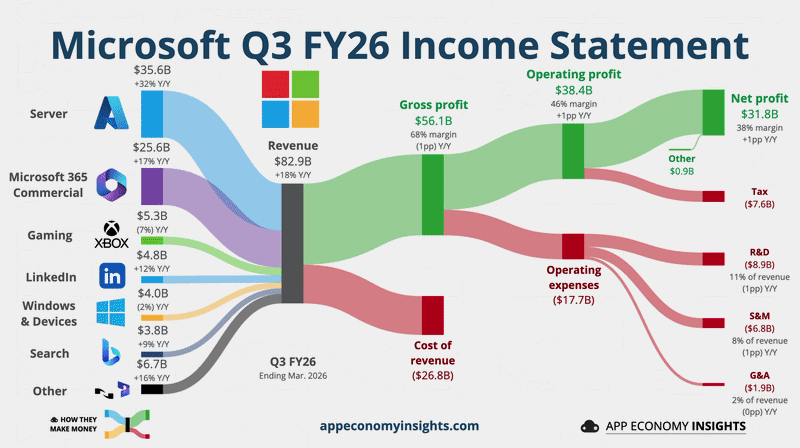
- Intelligent Cloud, which generated ~$34.700 M during the Q3 FY2026, growing by 30% year-on-yearwith Azure accelerating to near 40% rates in constant currency.
- Productivity and Business Processes, which contributed ~$29,900 M (+10%), where the layer of Copilot is already beginning to be reflected in a tangible way in the M365 Commercial ARPU and in the ticket enterprise expansion.
- More Personal Computing, which continues to be the segment with the highest structural pressure: Xbox content fell back by 5% y Windows OEM dropped a 2%, although the integration of Activision Blizzard continues to provide a massive user base and a IP catalog with long-term strategic value within the gaming ecosystem.
The centerpiece of the entire thesis remains cloud. Microsoft Azure currently holds a share of approximately 22-23% of the Global Cloud Infrastructure Market, against the 30-31% from Amazon Web Services and near the 12% from Google Cloud. It is not only the current quota that is important, but also the speed at which Microsoft has been closing the competitive gap with AWS, approximately ten points in just five years. And there is a structural advantage difficult to replicate. Microsoft already controls the entry point to enterprise IT spending through licensing, productivity and corporate software, Therefore, taking all of this into account, a large part of the upsell to Azure occurs within the same commercial stack and of the same sales team.
The restructured agreement with OpenAI, announced on April 27th, The new project reinforces this dynamic even more. Beyond the narrative component linked to IA, the relevant point is that OpenAI is consolidating its position as one of the world's largest compute customers within the Azure ecosystem, by incorporating this consumption directly into the annualized run rate of ~$37,000 M associated with the business of artificial intelligence. And that partially changes the nature of the thesis, it is no longer only a bet on future adoption of AI, but of an infrastructure that is starting to monetize real, recurring and measurable demand at hyperscaler scale.

$MSFT - Fundamental Analysis: Azure, Copilot and the Monetization of AI
| METRIC | VALUE | VAR. YoY | COMMENT |
|---|---|---|---|
| Total revenue (Q3 FY2026) | $82.9B | +18% | Beat consensus $81.5B |
| Intelligent Cloud | $34.7B | +30% | Main growth driver |
| Azure (c.c. growth) | 40% | +9pp | vs. 31% in Q3 FY2025 |
| Productivity & Biz Proc. | $29.9B | +10% | Copilot begins to move ARPU |
| More Personal Computing | $13.6B | +3% | Xbox -5%, Windows OEM -2% |
| EPS (adjusted) | $4.27 | +21% | Beat consensus $4.06 |
| Operating margin | 46.3% | +0.2pp | Above guidance 46.1% |
| AI revenue run rate | $37B annualized. | +123% | 20M+ Copilot paid seats |
| CapEx Q3 | $31.9B | $3.4B vs. est. | Below consensus |
| Guidance revenue Q4 | $86.7-87.8B | +13-15% | Azure 39-40% c.c. guided |
The results of the Q3 FY2026 confirmed something that, in my opinion, the market has not yet finished processing correctly, the Azure secular acceleration remains intact and, in fact, has reversed the narrative of multi-quarter slowdown that much of the consensus had begun to discount during 2025. Azure went from growing by 31% in Q3 FY2025 to do so by 40% in Q3 FY2026, with guidance for the Q4 in the range of 39-40%, clearly above the ~37% waiting for StreetAccount. This differential between expectation and execution is probably the actual core of the thesis.
Because the problem for the market is not only that Microsoft continues to grow, but it is growing faster precisely in the division where the consensus assumed structural standardization. And when a company of this scale returns to speed up on an already massive revenue base, the operational and valuation impact usually takes several quarters to be fully reflected in price.
Margins also do not reflect relevant operating impairment despite the aggressive investment cycle. The operating margin of 46.3% in Q3 ended up ranking even higher than the company's own company guidance (46.1%)while the CAPEX of ~$31.9Bn. remained approximately ~$3,400 M below consensus estimates. That partially alleviated immediate concerns about pressure in FCF y expenditure discipline. Even so, it is not only the isolated quarter that is important, Microsoft continues to generate one of the highest strongest operating cash flow in the market, The ~$100,000 M annualized before the impact associated with the CAPEX linked to AI and hyperscaler infrastructure.
The real fundamental risk is not so much in the size of the CAPEX, but on the speed at which this CAPEX is converted into revenue recognized y monetizable capacity. Microsoft anticipated approximately ~$40,000 M of CAPEX for Q4 and confirmed an investment cycle close to ~$190,000 M by calendar year 2026, including about ~$25,000 M additional resulting from the increase in costs in components y computing capacity. And that's where, personally, my reading differs quite a bit from that of the initial market reaction.
Because a company that has been operating for several consecutive quarters under a dynamic of demand exceeding supply does not appear to be investing against a speculative scenario or a empty narrative. What you are really doing is stacking capacity against a demand that already exists, that is already being monetized and that, moreover, cannot yet be fully met with the available infrastructure. And that changes the interpretation of the CAPEX, stops looking like defensive expenditure and it starts to look like accelerated construction of structural barriers to entry.
$MSFT - Position Structure: Action + Asymmetric Optionality via CALLS
My Position in Direxion Daily MSFT Bull 2X Shares (MSFU)
MSFU is the leveraged ETF of Direxion designed to approximately replicate the 200% of MSFT daily turnover before commissions and operating costs. The decision to combine this vehicle with direct position at Microsoft is not simply a response to an aggressive increase in exposure, but rather to a specific logic of convexity construction on assigned capital. In a context where the conviction about the structural direction of the movement is high and the time horizon for the thesis is between several weeks and a few months, the use of a leveraged instrument allows amplification of motion capture without the need to immobilize proportionally more capital.
The mathematics behind the vehicle is relatively straightforward, although its operational implications are not always correctly understood by the retail market. Under relatively favorable conditions of volatility and trend, a movement close to the 10% at Microsoft can be translated into approximately 18-20% of appreciation at MSFU as a result of the daily leverage and the effect of positive compounding when the trend is consistently maintained.
The problem arises when the directionality. The actual implicit cost of the leverage is not only in the ETF's fee, but also in the decay from daily rebalancing and compounding. In scenarios of high volatility, erratic movements or extended lateral ranges, MSFU can erode value even if Microsoft remain relatively stable over the aggregate period. And that's where I think a lot of people misinterpret these types of products, and I say this because it's important, they are not vehicles designed to be held indefinitely as a structural substitute for the underlying equity, but tactical tools for directional expression with a relatively defined time window.
Precisely for this reason, I believe that it fits with the time structure of this thesis. The hypothesis does not depend on maintaining exposure for years waiting for a slow expansion of multiples, but to capture a possible accelerated repricing linked to several relatively close catalysts, in which I include the Azure acceleration, progressive monetization of Copilot enterprise, expansion of the revenue associated with IA and an eventual normalization of market perception with respect to the current cycle of CAPEX. In a scenario where these catalysts are beginning to be reflected rapidly in price, the additional convexity of MSFU from being an unnecessary risk to become an important efficient asymmetric motion capture tool.
CALLS layer strike $30 expiration October 2025 on Direxion Daily MSFT Bull 2X Shares
With MSFU currently trading at ~$28, the calls strike $30 expiring October 2025 are slightly OTM, with an approximate distance to the strike of the 3-4% on the spot price of the ETF. Translated into the behavior of the real underlying, that level involves approximately MSFT trading in the ~$427 area., which represents a movement close to 3% from current levels of around ~$413. In practical terms, it is not a particularly aggressive displacement for a company of this capitalization if the market receives a earnings beat solid or a positive update related to Azure growth, Copilot monetization o IA infrastructure guidance.
The estimated premium for these calls moves approximately in the range of ~$3.00-$3.50 per contractwhich implies a initial cost close to 10-12% of notional equivalent. This places the breakeven at maturity around ~$33,20 on MSFU, considering a strike of $30 plus a average premium of approximately ~$3,20. Translated back into the underlying, we are talking about a Microsoft trading around ~$440-445, i.e., a movement close to the 6-7% from current levels. It does not seem a particularly extreme scenario within a thesis where the core precisely consists of a possible reexpansion of multiples y operational acceleration linked to AI.
The really interesting part of the structure is not just in the absolute payoff, but in the dynamic convexity derived from the behavior of the delta. A call OTM with five months to expiration would probably move initially in a zone of approximate delta 0.30-0.40. That means that, in the early phases of the movement, the option captures approximately one 30-40% of incremental change in assets. But the nonlinear nature of options sensitivity increases progressively as the price approaches the price of the product. strike and subsequently enters ITM.
This is where the actual payoff acceleration. A initial delta of 0.35 can be transformed relatively quickly into 0.50, 0.65 or even 0.80 yes Microsoft enters a phase of more aggressive repricing. And when that happens, the position starts to behave very similar to having direct exposure to MSFU, but having initially immobilized only the premium paid. In other words, the direct position on MSFU captures the linear motion of the thesis, the layer of calls enter convexity and amplification precisely in the scenario where the bullish thesis is developing with greater intensity and speed than expected by the market.
Linear model MSFU = 2x MSFT (instantaneous). Leveraged ETF suffers volatility decay at long horizons. CALL valued at maturity payoff, without discounting time value. Illustrative only.
Table of structure parameters
| PARAMETER | DATO | PARAMETER | DATO | NOTE |
|---|---|---|---|---|
| MSFT Price | $414 | Strike CALL MSFU | $30 | OTM ~3.4% |
| MSFU Price | ~$29 | Breakeven CALL | $33.20 | +14.5% MSFU |
| Estimated premium | ~$3.20 | Estimated delta | ~0.35 | CALL OTM 5M |
| Dist. to strike | +3.4% | MSFT equiv. strike | ~$427 | +3.1% MSFT |
*Estimated premium. Approximate greeks (Black-Scholes, IV ~30%). They do not constitute exact option chain data. For illustration of structure only.
MSFT - Catalysts: Copilot Monetization and AI Spending Cycle
Catalysts with defined time window
The Q4 FY2026 earnings, planned for July 2026, is probably the most relevant event within the time horizon of the calls about MSFU. After several quarters in which the market began to discount structural slowdown in cloud, a confirmation of Azure growing again in the 39-40% range would definitively consolidate the reacceleration narrative. And there the impact can be significant, because the current positioning still reflects quite a bit. skepticism The company's performance is not a surprise in terms of the sustainability of this pace. A clearly positive surprise could very well translate into a movement of 8-12% on Microsoft in a single session, placing MSFU comfortably above strike $30 and aggressively accelerating the delta of the calls.
The second key catalyst is the actual monetization of Copilot enterprise and the speed of conversion to licenses M365 E5. The ~20 M of paid seats represent only the starting point, what the market will really be trying to measure over the next few quarters is the rate of expansion and, above all, the Incremental ARPU derived from IA within the stack enterprise. Many long-cycle corporate renovations are currently being renegotiated and some of that impact should start to be progressively reflected in both the backlog as in revenue visibility during Q4 FY2026 and FY2027.
There is also a less immediate catalyst, but potentially very relevant at a global level. narrative and valuation, a possible OpenAI IPO between H2 2026 and H1 2027. Microsoft maintains approximately 27% of the OpenAI economic equity together with strategic rights y non-exclusive licenses until 2032. If OpenAI market at multiples comparable to those currently being discounted by the private market in generative AI, the implicit valuation of Microsoft's shareholding could begin to be reflected much more explicitly within the balance sheet and act as a additional re-rating catalyst.
Real risks
The main fundamental risk remains that the current cycle of CAPEX end up becoming a temporary liquidity trap. The ~$190,000 M committed by 2026, together with the increase in costs in components, energy y computing capacity, involve pressure on FCF over the next few two or three quarters. As long as the market perceives that the demand continues to absorb that capacity, the narrative remains constructive. The problem would arise if Azure start to slow down before sufficiently monetizing the deployed infrastructure. There the compression of multiples could be quite violent, because a large part of the current thesis depends precisely on that capability ending up rapidly becoming incremental revenue.
The second significant risk is regulatory. Both the European Commission as the U.S. DOJ maintain active processes or follow-up on the relationship between Microsoft and OpenAI, in addition to possible practices of bundling between M365, Copilot and Azure. The risk is not only economic, but strategic, any action that would limit Microsoft's ability to vertically integrate your ecosystem could partially weaken the model of upsell which is currently one of its largest competitive advantages versus peers.
Finally, there is a competitive risk that the market probably undervalues at times. Google Gemini continues to gain traction within accounts linked to Google Workspace, AWS Bedrock offers an approach multi-model with a reduced sense of lock-in for certain enterprise customers, and Goal AI continues to move aggressively with LLaMA within the segment open source and deployments on-premise. Microsoft probably maintains today the stronger competitive positioning within the enterprise AI stack, but that does not mean that the advantage is impregnable and permanent.
Revaluation Scenarios
In a optimistic scenario, the thesis requires that several pieces begin to align within the same time horizon.
The first of all, Azure should be maintained or even reaccelerate growth toward the 43-45% range during FY2027, confirming that the current cycle of investment in AI infrastructure is not only sustaining demand, but expanding it. The market needs to see that the increase in CAPEX is really translating into monetizable capacity y growing enterprise backlog.
The second, Copilot enterprise must begin to demonstrate tangible monetization on the installed base of M365. It is not necessary for the market to see full mass adoption yet, it is enough for the paid seats clearly move ahead of the ~20 M current and that the ARPU associated with E5 begin to reflect visible quarter-over-quarter expansion. If Microsoft succeeds in converting IA from productivity narrative to recurring incremental revenue, the market is likely to begin to revaluing the company as an AI infrastructure platform and not only as a traditional hyperscaler.
And the third, the cycle of CAPEX should no longer be interpreted as pressure on FCF and start to look like construction of structural barriers to entry. If Microsoft for two or three consecutive quarters that it continues to operate under the dynamics of the demand exceeding supply, The market is unlikely to continue to penalize spending in the same way.
With these conditions fulfilled, a re-rating to ~36-38x forward EV/EBITDA multiple, levels consistent with companies perceived as clear leaders of a secular cycle of technological infrastructure, would reasonably lead to MSFT to an approximate range of ~$550-620 per share, which would imply a potential revaluation of approximately +33% to +50% from current levels near ~$414.
In this scenario, MSFU could be located approximately in the area of ~$40-46, depending on the effect of compounding and the path volatility. In this context, the position in CALLS strike $30 due October would go from being slightly OTM to enter deeply ITM, by activating the delta expansion and generating a nonlinear payoff acceleration. Considering a approximate input premium around ~$3-3.5the potential return on calls could far exceed the +200%/+350% if the upward movement develops with sufficient velocity within the time window of the operation.
An additional event, such as a OpenAI IPO or a Explicit monetization of Microsoft's strategic involvement in the OpenAI ecosystem., could act as accelerator of this scenario without even waiting for several quarters of additional expansion in Azure.
In a base scenario, the thesis does not require heroics, it simply requires consistent execution.
Azure growing at around 35-38%, Copilot progressively advancing within the enterprise renewals and the CAPEX stabilizing without significant deterioration of the cash flow would be sufficient to sustain the current narrative. There is no need for a immediate explosion of monetization in AI; The market must stop discounting structural slowdown and begin to accept that Microsoft continues to capture a disproportionate share of enterprise spending linked to cloud and artificial intelligence..
In this context, a range of ~$460-510 would imply a moderate expansion of multiples to ~30-33x forward EV/EBITDA, completely justifiable for a company that continues to grow in cloud near 40%, generates more than ~$100,000 M of annualized operating cash flow and probably maintains the more integrated competitive position within the global enterprise stack. This range would imply a revaluation from approximately +11% to +23% from current levels near ~$414.
Under this scenario, MSFU would probably move to an approximate zone of ~$33-36. The position in CALLS strike $30 due October enter ITM progressively, activating delta expansion and allowing the convexity start to play in favor of the structure. Considering input premiums near ~$3-3.5the potential return on calls could be approximately in the range of +40% to +120%, depending mainly on the speed of movement and the time of occurrence of the expansion of multiples.
The most relevant temporary catalyst in this scenario is still the earnings for Q4 FY2026 in July. If MSFT confirms Azure growth above expectations and improves visibility on Copilot monetization, the movement towards the top of that range could be produced relatively quickly.
In a bearish scenario the thesis does not need to collapse completely, it is enough for the market to stop giving credit to the current investment cycle in IA and infrastructure.
Yes Azure begins to decelerate again towards the 28-30% during FY2027, the market is likely to interpret that the massive deployment of computing capacity anticipated the real demand. And then the problem would cease to be solely operational and would become a valuation problem. The CAPEX would go from being perceived as strategic defensive investment to be interpreted as structural margin pressure, return on invested capital y future free cash flow generation.
The situation could deteriorate further if Copilot enterprise adoption beyond current levels or if the company's Incremental ARPU linked to IA begins to disappoint in the face of a extremely high expectations that today are still partially incorporated in price. Because a large part of the current strategic premium depends precisely on which Microsoft to transform Generative AI at large-scale enterprise recurring revenue.
In this context, the compression of multiples could be relatively aggressive. A contraction toward ranges close to ~24x forward EV/EBITDA would reasonably lead to MSFT to an approximate area of ~$320-360 per share. There the market would probably reprice Microsoft more like a mature mega-cap with normalized growth and pressure on margins that, like the main structural leader of the next cycle of technological infrastructure.
This movement would also have an amplified effect on MSFU, approximately replicating the 200% of Microsoft's daily turnovera drop of 15-20% at MSFT could easily translate into corrections close to 30-40% in the ETF, especially if the movement is accompanied by volatility expansion and progressive deterioration of momentum. And here appears one of the structural risks of the vehiclethe decay from daily compounding on stage side-bassists or of high volatility.
In a context where Microsoft loses trend and enters a phase of prolonged compression of multiples, MSFU ceases to behave like a efficient directional convexity tool and begins to eroding value at an accelerated rate even if the underlying temporarily stabilizes the price. This risk is also transferred directly to the CALLS strike $30 expiration October. If MSFU loses support and remains below the strike for too many weeks, theta decay y implied volatility compression would quickly begin to deteriorate the time value of the position.
The area of ~$350 in Microsoft also begins to coincide with levels where valuation, cash flow y technical structure would probably attract again long-term institutional demand. Below that range, however, the market would no longer be questioning only the rate of growth of Azure, but rather the secular narrative linked to AI and cloud hyperscaler on which much of the thesis is currently based.
$MSFT - Technical Analysis: Bounce from Structural Support and Decision Zone
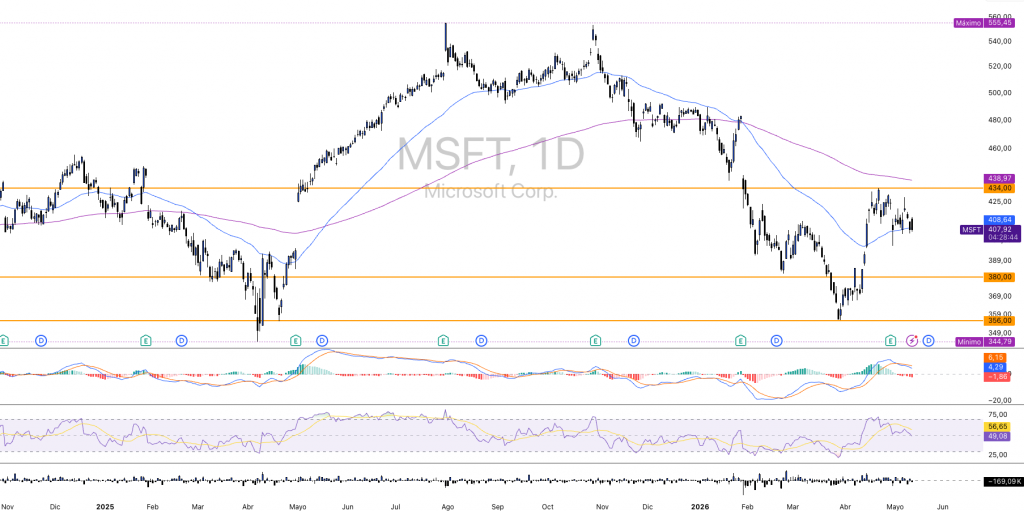
The Microsoft's technical structure over the last twelve months continues to reflect a relatively clean correction from all-time highs, followed by a rebound that, although significant, has not yet fully confirmed. upward structural continuity. The asset marked record highs at ~$555.45 the July 31, 2025 and subsequently entered a corrective phase that ended up driving the price down to ~$356,07 during the last days of March 2026, which is a drawdown close to 35.9% since highs. Since that low, the price has managed to partially recover ground to the current area of ~$410-420.
On a technical level, the current structure is starting to be interesting because the rebound occurred precisely from an area where the following coincided long-term support, valuation compression y progressive re-entry of institutional flow. The first area of relevant support is currently in the range ~$380-385, area where a large part of the volume accumulation during the April rebound. Below, the level of ~$356 continues to function as absolute support of the current structure, If it is lost, losing it would probably partially invalidate the reacceleration thesis and would open the door to a much more aggressive compression of multiples.
The immediate resistance appears around ~$434, This level is especially relevant because it coincides approximately with the 200-session daily moving average and with an area where several institutional desks have identified the main short-term technical ceiling after earnings. Moreover, this range has additional importance within the structure of the trade because it practically coincides with the equivalent level over Microsoft necessary to ensure that the CALLS strike $30 on Direxion Daily MSFT Bull 2X Shares start to enter clearly ITM and accelerate delta significantly.
The moving averages are also beginning to show a progressive improvement in short-term momentum. The average 50 sessions is already below the current price, confirming tactical recovery from March lows, while the average of 200 sessions continues to act as main dynamic resistance in the area ~$430-435. Technically, exceeding that average with significant volume would probably change quite a bit the structural perception of the graph and would open the way to a more aggressive extension of the movement.
The momentum indicators partially accompany this reading. The MACD (12,26,9) crossed to the upside after the March minimum and the histogram currently remains positive, reflecting that the impulse buying is still active despite recent consolidation. The RSI (14) moves around levels of 55 on daily chart, a still relatively neutral zone, but with enough room to extend into ranges of 65-70 if the buying flow continues to accelerate.
The current technical bias is still neutral-bullish, although not yet fully confirmed. The real structural validation would probably arrive with a sustained rupture above ~$434 accompanied by volume expansion and positive continuation in Azure y AI guidance. If that happens, the chart would no longer look like a simple technical rebound within a correction and it would start to look like the beginning of a new impulsive phase in line with the fundamental thesis.
Synthesis
What the market is probably not yet fully pricing is the simultaneous combination of Azure reacceleration y real AI monetization on a scale that it is difficult to classify as mere storytelling any longer. When the business associated with artificial intelligence passes from a run rate close to ~$13,000 M in Q2 FY2025 to approx. ~$37,000 M in Q3 FY2026, in just five quarters, the discussion ceases to focus on whether or not the AI can be monetized and focuses on something much more relevant, how fast can demand continue to grow relative to the capacity that Microsoft is aggressively building today.
And this is precisely where the main risk of the thesis. The problem is not so much the AI competence, because it is likely Microsoft currently holds the most integrated and monetizable enterprise ecosystem on the market, but the timing of return on CAPEX. If the ~$190,000 M committed by 2026 do not end up translating relatively quickly into monetizable computational capacity y visible expansion of revenue in Azure before FY2027, the market will inevitably begin to question capital discipline, return on investment y margin sustainability. That would be the scenario that would probably lead to MSFT to the estimated downward range ~$320-360. It is not my central scenario, but precisely for that reason I think it deserves to be. clearly stated.
My personal reading of the current moment is that Microsoft is probably at the point of maximum short-term relative post capex-shock pessimism, and that these types of contexts are often precisely where the positions built with fundamental conviction offer better asymmetric relationship between risk and expected return. The rebound from the lows of ~$356 has already recovered approximately 16%, but has not yet reached the technical resistances of real relevance, which implies that it continues to exist reasonable technical path if the fundamental narrative continues to be validated over the coming quarters.
The logic of simultaneously maintaining direct position at Microsoft and exposure through CALLS strike $30 on MSFU due October responds exactly to that reading. The position in MSFT captures the linear movement within a scenario of gradual recovery y moderate expansion of multiples, the CALLS, on the other hand, they add nonlinear convexity precisely in the scenario where a catalyst, especially the July earnings, produces a dislocated movement able to carry Microsoft quickly above the zone ~$434-440.
If this movement occurs within the time window of the options, the structure of CALLS allows multiply the profitability of the position using only one fraction of total committed capital as an initial cost via premium. And therein really lies the trade asymmetrythe maximum downside of that layer is defined from the beginning, while the upside remains open if the Azure reacceleration and the Copilot monetization end up forcing a more aggressive repricing of what is currently discounted by consensus.
Microsoft is still, in my opinion, the IA infrastructure asset with higher balance sheet quality, major enterprise ecosystem depth and larger documented evidence of actual monetization within the currently quoted market. The position is built specifically for the scenario where the market ends up reflecting that in price before October. The rest, really, is time management, volatility and execution.
 Spanish
  English
  German
  French