





In my analysis of Microsoft Corporation ($MSFT), which you can consult here, I argued in some detail why I thought the market was making a clear misinterpretation. The correction close to 25% from the highs of July 2025, which took Microsoft from ~$555 to touch the ~$356 area at the end of March, did not reflect any real fundamental deterioration in my opinion. It reflected fear. The market had decided to treat the CAPEX increase committed for 2026 as a profitability destruction problem, when in fact it was a defensive investment to sustain leadership in infrastructure and computational capability. I interpreted it from a different approach than the consensus, and that was the basis on which I built the position.
The structure I assembled had two deliberately differentiated layers. On the one hand, direct position in Microsoft, which captures the linear motion of the thesis. On the other hand, I structured convex exposure through calls on the leveraged ETF Direxion Daily MSFT Bull 2X Shares (MSFU), strike $30 and maturity October 2026, which is the main focus of this article. The first layer monetizes the gradual recovery; the second layer introduces non-linear convexity precisely in the scenario where the bullish thesis unfolds faster than the market discounts. The maximum loss of that second layer was defined and limited to the premium from day one.
Execution Timing: Capturing Post-Earnings Irrationality
It is important to specify the timing, because this is exactly where the logic of the operation lies. The Q3 FY2026 results were released on April 29th., So when I opened the position on May 4th the numbers were already on the table. I didn't go in speculating on what earnings would say. I entered buying the market's reaction to results it was already expecting, and that reaction seemed simply irrational to me. Azure had accelerated to 40% in constant currency versus 31% a year earlier, operating margin had exceeded the company's own guidance, the AI business was running at an annualized run rate of ~$37,000M growing 123% year-over-year, and CAPEX for the quarter had come in even below consensus estimates. These were, objectively, solid results.
And yet, the market continued to sell the stock, anchored by the psychological impact of the guidance from ~$190,000 M of committed CAPEX for the exercise. That is where the inefficiency appeared, and where I decided to act. The market was discounting the expense, but was still not giving any credit to the return that the same expense was already starting to generate. This is not the first time something like this has happened. Initial infrastructure build-out phases often compress multiples temporarily before they become drivers of structural earnings expansion, and I understood that Microsoft was precisely at that point, probably at the maximum short-term relative post capex-shock pessimism.
There were also more tactical reasons that reinforced the entry. The rebound from the ~$356 area had already taken place on a level where long-term support, valuation compression and progressive re-entry of institutional flow coincided, so that the technical-fundamental floor was reasonably formed. And this was compounded by an important factor in the price of the options themselves, with earnings already posted, implied volatility had discounted the event and was compressed, which is just what a call buyer wants to see. Buying options with volatility inflated before an outcome is paying the expensive premium; buying them after the event is resolved, with IV already relaxed and MSFU still depressed, cheapened the convexity relative to the potential path. More importantly, the really relevant catalysts were left entirely up front, not behind. The Q4 FY2026 expected in July, the progressive monetization of Copilot enterprise and an eventual IPO of OpenAI were events that the price did not yet pick up and that fit within the time window of the options.
Leverage Dynamics: Aggressive Expansion of Delta through MSFU
The decision to express convexity through MSFU and not through direct options on MSFT was also not accidental. MSFU replicates approximately 200% of Microsoft's daily movement, which means that, under sustained positive trend conditions, the delta of the call expands much faster. An option that starts with an approximate delta of 0.30-0.35 can become 0.50, 0.65 or even 0.80 in a matter of weeks if the actual underlying enters a more aggressive repricing phase. And when that happens, the position begins to behave much like having direct exposure to the ETF, but having tied up only the premium paid.
It is important to understand that these types of products are not designed to be held indefinitely. The real cost of leverage is not just in the ETF fee, but in the decay derived from daily rebalancing and compounding, which in sideways or high volatility scenarios erodes value even if Microsoft remains stable. That's why they fit so well with a thesis like this, that does not depend on waiting years for a slow expansion of multiples, but to capture accelerated repricing linked to relatively close catalysts. In this context, the convexity of MSFU ceases to be an unnecessary risk and becomes an efficient asymmetric capture tool. This is exactly the same logic that I already applied at the time with the calls on SPXL and SPXS, which you can see in the analysis below. here.
Catalyst Synchronization: The Transition to Repricing‘
The thesis has not been sustained in a vacuum. Over the last few weeks, a series of very specific catalysts have piled up, one after the other, validating the reading I made on May 12, and explaining why Microsoft has regained ground as fast as it has.
The first, and probably the most visible one, was Bill Ackman. In mid-May, Pershing Square disclosed a position of . ~$2.1 billion at Microsoft, The company's valuation, built up progressively since February, took advantage of the correction. Ackman's argument was straightforward, he considered MSFT's valuation at that time, around 21 times forward earnings and in line with the general market, as a historical anomaly for a company that controls two of the most valuable franchises in enterprise software, Azure and M365. This is exactly the same reading I was advocating, and when someone with your institutional visibility articulates it publicly and with position behind them, the market tends to listen.
The second came from institutional analysis. On May 27th, Morgan Stanley published a rather elegant model, the so-called revenue-per-megawatt framework, built by analyst Keith Weiss. The idea is to divide Microsoft's overall cloud revenue by installed datacenter capacity, measured in megawatts, to get a productivity metric that can be tracked over time. What is relevant is what is implied by the committed expansion cycle, which would take Microsoft from about 5 gigawatts in 2024 to about 20 gigawatts in 2028. If that infrastructure is monetized even conservatively, consensus bottom-up models could be underestimating Azure AI's implied revenue for the next few fiscal years in the range of 59% to 91% on margin assumptions. Morgan Stanley maintains a price target of $650, which still implies considerable upside, and the broad consensus converges on a median target near $557, also above where the stock was trading at the close.
The third catalyst was, interestingly enough, Snowflake. At the end of May, it published results that the market interpreted as a relevant industry signal that the feared ‘SaaSpocalypse’, i.e. the fear that AI would make subscription-based enterprise software obsolete, was being greatly exaggerated. The platforms at the heart of AI workflows were not only not being replaced, they were accelerating. For Microsoft, which is probably the most integrated enterprise cloud and AI ecosystem in the market, that signal read directly, and the stock reacted to the upside.
And the fourth, which practically coincides with the closing of the transaction, is Microsoft Build 2026. The developer conference kicks off in San Francisco with Satya Nadella's keynote, and the announcements reinforce where the company is headed, Agent Mode for Copilot in Microsoft 365 with persistent multi-agent capabilities, GitHub Copilot evolving into a standalone coding agent, Azure AI Foundry consolidating as an enterprise control panel for orchestrating agents, and Copilot Runtime for Windows, which enables local AI inference in any application without the need to go through the cloud. The very choice of San Francisco as headquarters, as opposed to the usual Seattle, is in itself a statement of intent. The underlying message is that the next platform cycle is no longer Windows or Office, but the AI agents., Microsoft wants to be the infrastructure on which that cycle runs.
What all these catalysts confirm, and what I argued back in May, is that the massive CAPEX committed for 2026 was never a red flag, but a positioning signal. The demand that Microsoft is serving already existed, was already being monetized, and is going to continue to grow. The market simply took a few weeks to process it. The position, on the other hand, had already been discounted since May 4.
Partial Closing Execution: Crystallization of Benefits in Trend Scenario
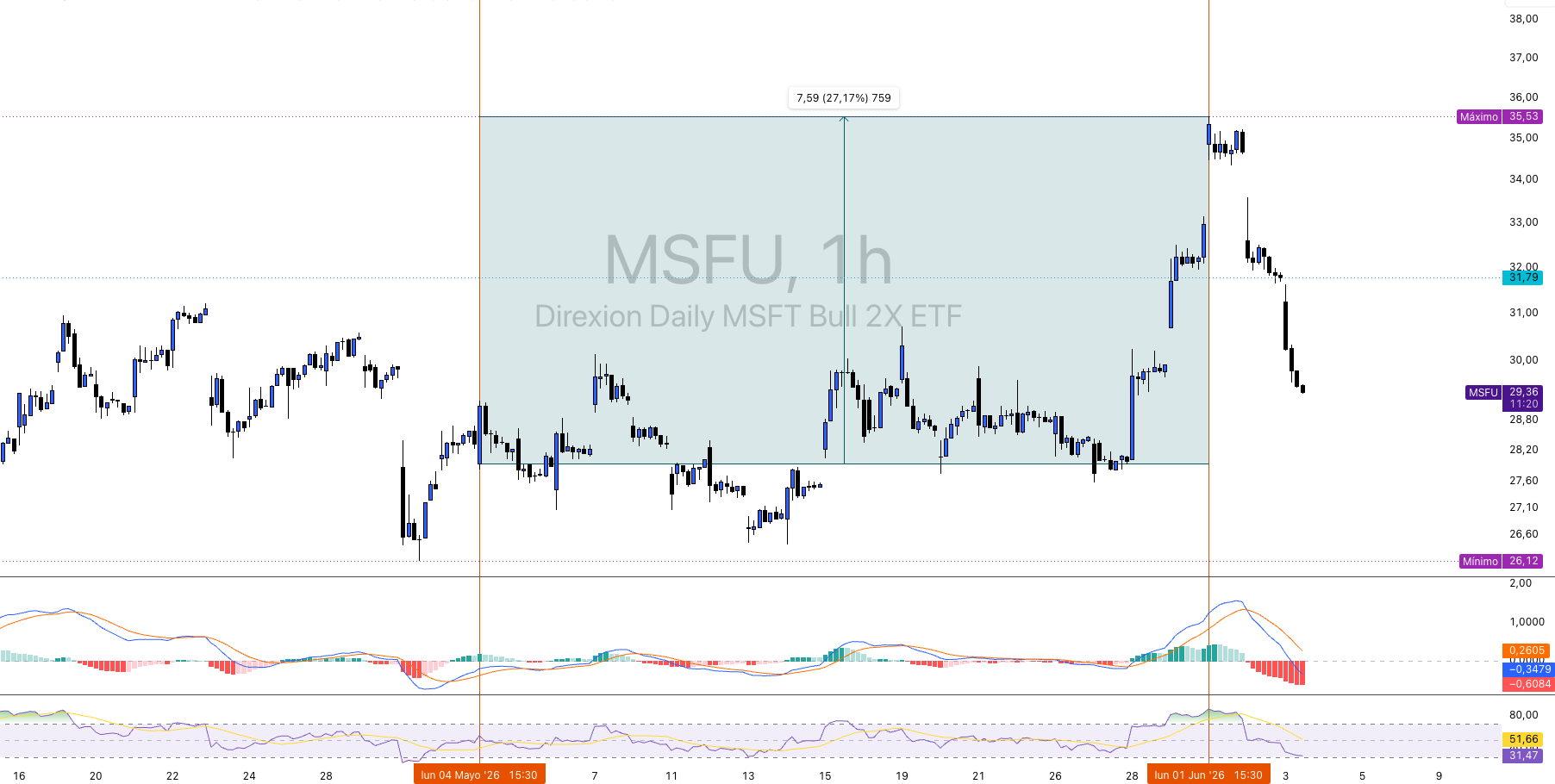
On June 1, 2026, with MSFU already clearly trending and Microsoft's move confirming the structural direction put forward in the thesis, I executed the close of half of the position, at a price of $7.9, $3.7 entry on May 4. Only that half closed with a yield of close to +113,51% on the invested premium, over a period of about 28 days. I executed the exit practically at the highs of the move, just before MSFU started a sharp correction in the subsequent sessions. I am keeping the other half of the position open.
And this is no accident, but a deliberate part of how I carry out this type of structure. By realizing half of the contracts I have comfortably recouped the entire premium invested in the entire position, so that the contracts that I keep open are, in terms of risk, essentially financed. The initial capital is already back and secured; what is still running is profit. That allows me to maintain convex exposure to the upside leg that may still lie ahead, linked to the July Q4 FY2026 and the rest of the catalysts, but without risking a single euro of the original cost. It is the cleanest way I know of combining profit realization with maintaining optionality.
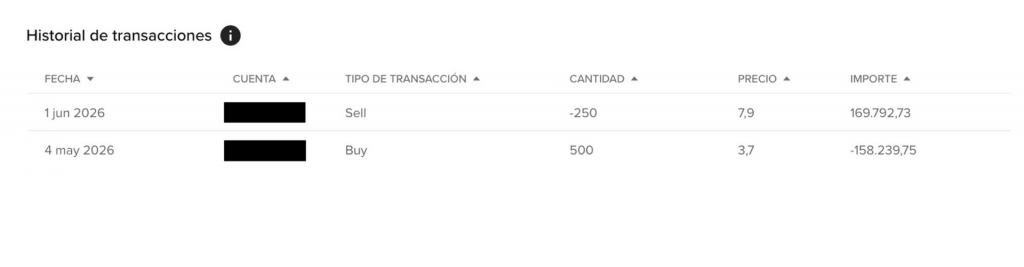
I did not close the first half because the thesis had disappeared, but rather because that part of the position had already fulfilled its function, and there is an important difference between the two. The methodology I apply is not to hold options to expiration waiting for the optimal scenario, but to recognize when the convexity has already generated the return it was designed for, and act before the theta decay begins to erode what the directional move has already built. An entry at $3.7 and a close at $7.9 in just four weeks implies that the market has already at least partially reflected the repricing that the analysis anticipated. The delta of the calls, which started from levels close to 0.35, had expanded considerably, and from that point the relationship between residual convexity and reversal risk begins to change. Realizing half at that threshold, and letting the rest run with the premium already recovered, is precisely what balances the two.
The thesis on Microsoft, it should be stressed, remains intact. The acceleration of Azure, the progressive monetization of Copilot enterprise and the CAPEX cycle that the market still interprets with some skepticism remain the same arguments I documented on May 12, and July's Q4 FY2026 will continue to act as a relevant catalyst. What has been realized is only half of the options layer; the other half remains alive, capturing traction with no added risk cost, and the remaining exposure to Microsoft, via direct equity, remains equally active. I show the performance below.
 Spanish
  English
  German
  French