





The week began with background noise, where the Trump administration had been for weeks with noticeably toughened discourse toward Tehran, talk of expanded sanctions, «maximum pressure 2.0» rhetoric, and something much more relevant, operational language that went beyond the usual coercive diplomacy.
The backdrop was a WTI trading in the range of 70-72 dollars., The market, under pressure from Chinese demand data and the prospect of a possible OPEC+ agreement to increase production, added to a brent with parallel behavior that could also pressure the price. The market, in its reading, continued to look at the supply side with more concern about excess than deficit. That consensus, I think, had an important crack, it was not pricing in the risk of supply disruption in the Persian Gulf.
The Strait of Hormuz is the most critical energy bottleneck on the entire planet, with approximately 20 million barrels per day transiting through it, equivalent to 20% of global crude oil consumption. Any military action, or even the credible threat of one, has the potential to move the price of a barrel violently and quickly. That asymmetry was the one I sought to exploit.
Signals: Reading and mental process
Signal: Aerial military positioning
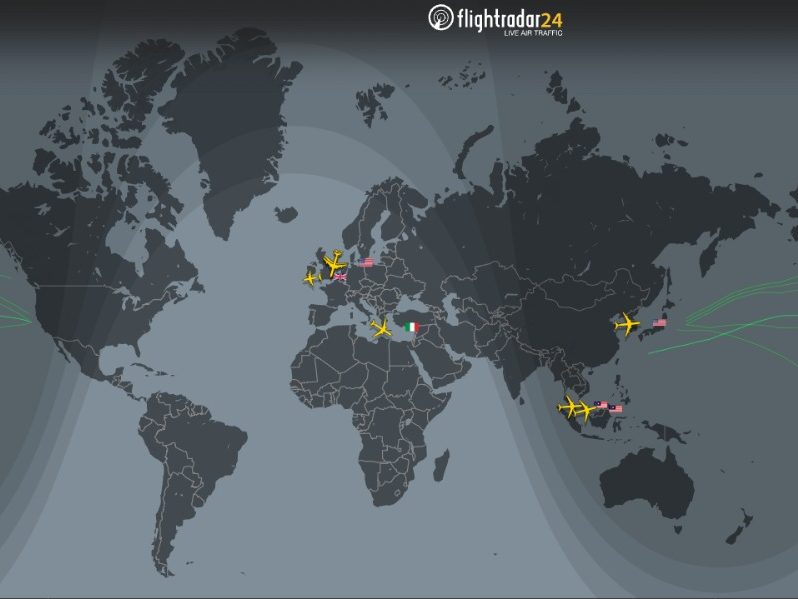
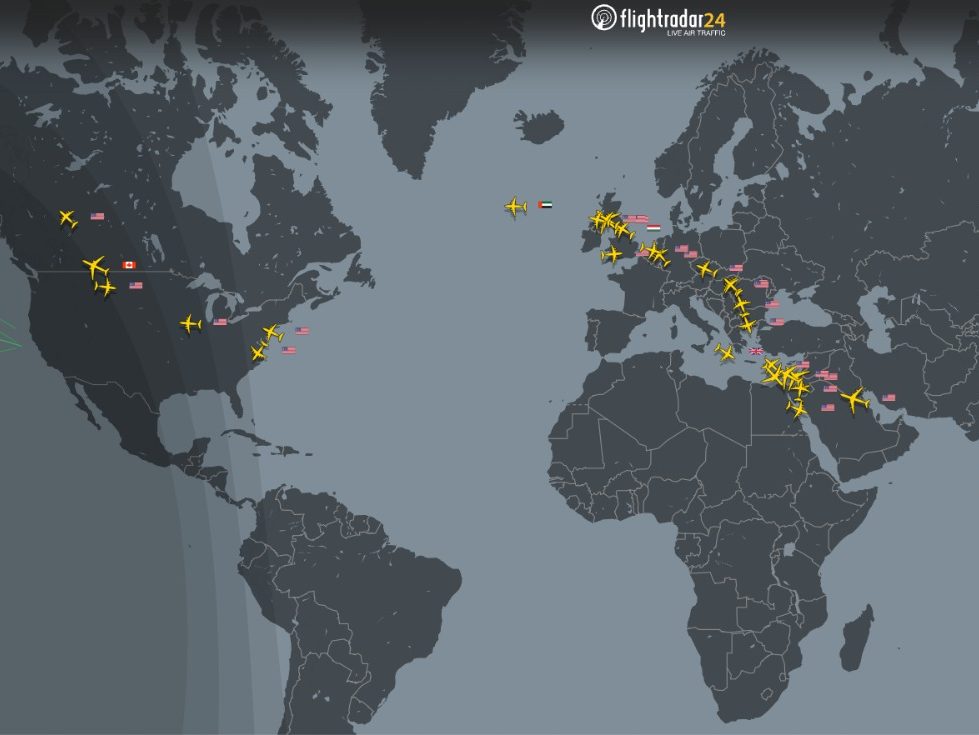
On Monday afternoon, February 24, I detected an unusual strategic movement through Flightradar24. A relevant increase in military aircraft traffic was observed in Northern Europe and, especially, in allied bases in the Eastern Mediterranean.
These were not isolated flights, but unusual take-off frequencies for a non-holiday Monday, with trajectories consistent with a progressive logistical deployment to the east.
In open source intelligence (OSINT), the key is not to identify a “military aircraft,” but to detect patterns. In this case, a sustained 48-hour trend constituted a clear signal.
The behavior he was seeing was consistent with a process of fuel-oriented logistics prepositioning, The project was a repositioning of capabilities to ensure in-theater energy supply prior to a possible larger-scale operation. This required not only a show of force, but also the preparation of the necessary infrastructure to sustain actual operational consumption.
Signal: USS Gerald R. Ford enters the Mediterranean Sea
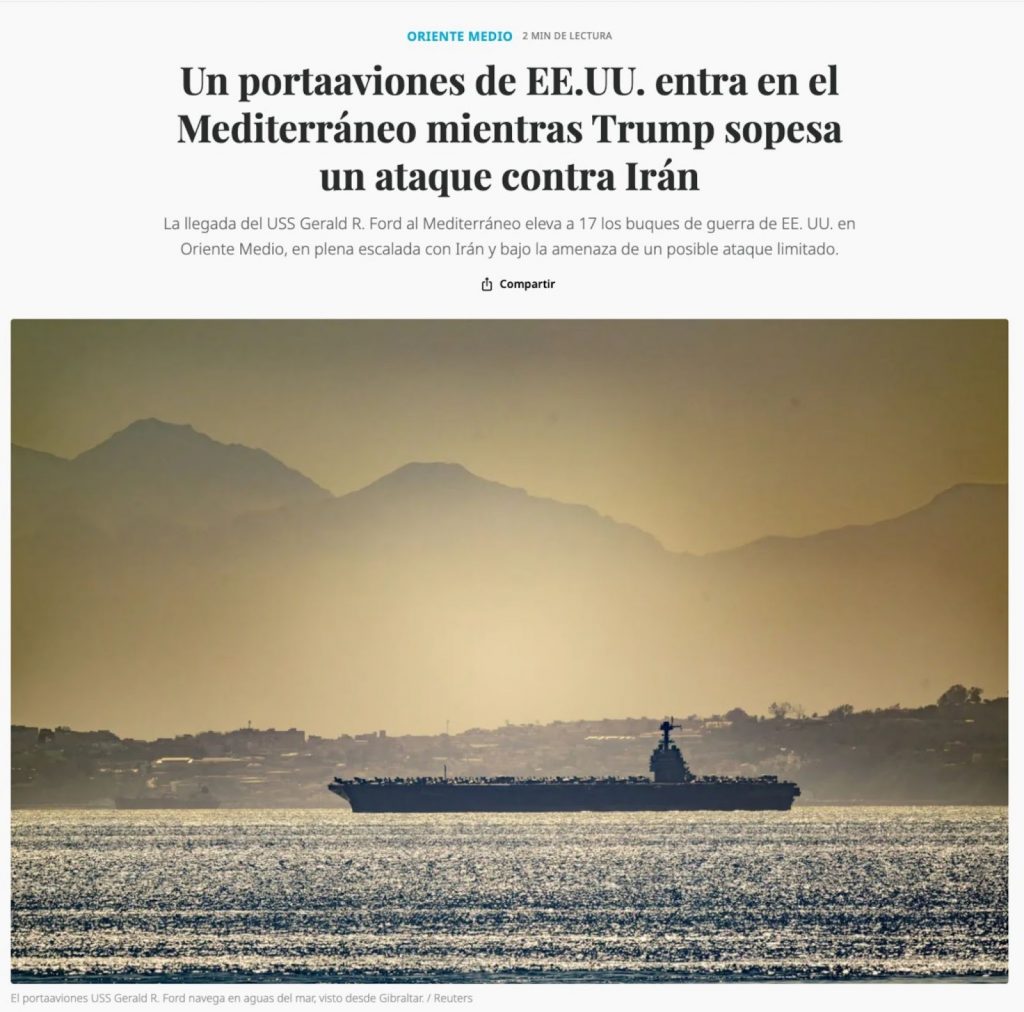
On Tuesday, Feb. 25, via MarineTraffic and open defense sources, the aircraft carrier USS Gerald R. Ford had entered the Mediterranean, bringing to 17 the number of U.S. warships deployed in the Middle East. The concentration included naval assets in the Persian Gulf and Arabian Sea.
America's largest aircraft carrier is not an asset that moves by bureaucratic inertia, its deployment involves weeks of planning, logistical coordination and political decision-making at the highest level. Watching the Gerald R. Ford position itself in the Mediterranean while military aircraft were amassing at allied bases was no coincidence; it was beginning a coherent operational narrative.
Signal: Trump's Statements: The Threshold of Operative Language
During the week, leaked conversations and public statements by Trump began to circulate in which he openly mentioned a limited strike against Iranian nuclear infrastructure.
The justification was again the Iranian nuclear program, the same one that was “destroyed” last year, the one that Trump trumpeted as a clear victory. operational delay, not a actual elimination of nuclear capacity.
What really mattered to me was not the content itself (this type of rhetoric has precedents) but the register itself. A sitting president rarely verbalizes in such terms without there being, at least, one underlying operational planning. His tone and speech was unusually direct, lacking the strategic ambiguity typical of diplomatic warnings. Although I also have to say, we are practically accustomed to this characteristic Trump behavior.
I contextualized these statements along with the positioning of military assets and read it as a clear and composite pressure component, not necessarily the announcement of imminent action, but a sign that the window of opportunity is closing. decision was open.
Signal: Information flow in defense circles
Parallel to all of the above, specialized media such as Breaking Defense y War on the Rocks began to publish analyses, without explicitly confirming anything, they were building the context of a window of military action in the February-March period. Unconfirmed intelligence reports pointing in the same direction were circulating in Washington think tank circles. This type of leak, gradual, decentralized, with no single source, is often more reliable than the front-page headline, precisely because it does not obey a strategic communication narrative.
Signal: Oil Market Reaction: Where the Curve Doesn't Lie
As of Tuesday, February 25, WTI began to show an upward trend. increasing geopolitical risk premium. What I found most significant was not the spot price movement, but what was occurring in the forward curvethe contango was compressed. Short-term contracts appreciated relative to those with longer maturities, indicating that the the physical market, the most informed, anticipated a supply tension near the end of the year..
In addition, there was a significant increase in the open interest in out-themoney call options with short maturities. Protection, or exposure, was being bought on the upside with urgency.
In commodity markets, such a flow pattern has precedent, it is the typical capital trail where the best informed buy in time before the news arrives.
In other words, buy on the rumor and sell on the news. A clear logic in which the market discount first and validate later.
Signal: elevated VIX and asymmetric skew in oil options
The VIX remained elevated without collapsing, which in practical terms meant that the market had not ruled out the tail scenario. Under normal conditions, a high VIX without a new catalyst tends to unwind. That it did not reinforced the assumption that there was a latent risk not yet fully discounted.
The final piece of information that closed my analysis was the asymmetric skew on USO options, the benchmark oil ETF, and in Crude Oil (CL) futures, the implied volatility of the calls was significantly higher than that of the equivalent puts..
The options market, historically more efficient at incorporating private information, was saying that the risks were more bullish than bearish, and that this asymmetry was recent.
Thesis construction: The bullish tail scenario
The signals taken together, over the course of 72 hours and through different sources, were building something different, a convergence of indicators consistent with a scenario of military attack against Iran in a short or very short time horizon..
My thesis was articulated around three distinct risk vectors.
The first was the risk of Partial or total closure of the Strait of Hormuz., an Iranian retaliation case, with an estimated impact of 15 to 30 USD per barrel in a matter of days.
The second was the destruction of Iranian export infrastructure, Iran exports approximately 1.5 million barrels of oil per day, which alone is enough to produce about 1.5 million barrels of oil per day. would immediately stress the global supply-demand balance.
The third was the geopolitical contagion effect, any escalation in the region would activate risk premiums in the Gulf producers as a whole, regardless of whether Saudi Arabia, Iraq or the UAE were directly involved.
The logic of the position was asymmetrical. If the scenario did not materialize, the WTI/BRENT could immediately fall back from its current levels, with an immediate limited loss.
If it materialized in any of its variants, the upward movement would be fast and violent. That risk-reward asymmetry was the core of the operation.
Execution: Input, instrument and sizing
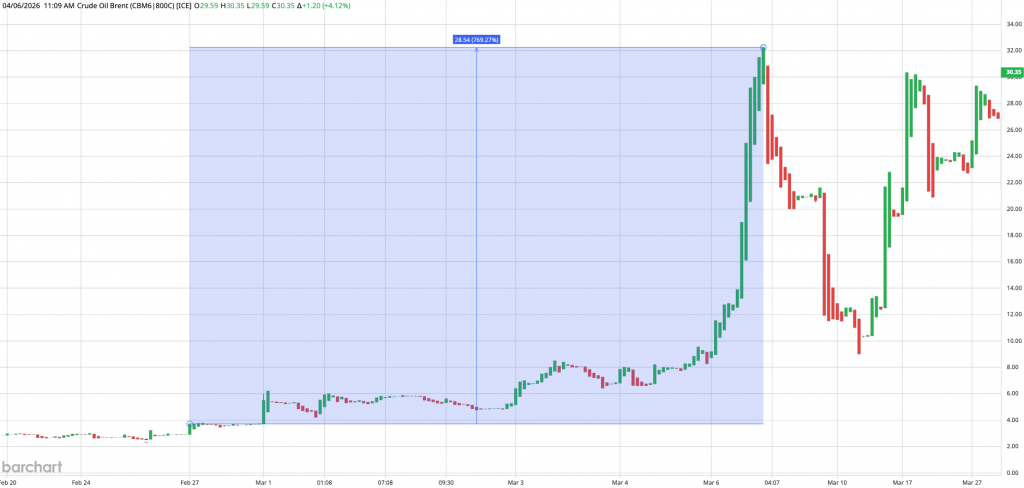
I executed an entry on Friday, February 27, on Brent futures ($COIL) at long position via call options at strike 80.
Friday as an entry day was no accident. In a geopolitical scenario of this nature, the weekend risk acts as an amplifier. Markets close, but events do not, and even more so considering Trump's clear track record in this type of context. Any development during Saturday or Sunday, a statement, a troop movement, or a leak, could translate into a bullish gap on Monday, impossible to capture from a flat position. Assuming this risk was part of the strategy.
The sizing of the position was calibrated in function of the level of conviction (high) and the distance to the level of invalidation of the thesis, The risk management was simple, the total loss of the premium paid. A structure that combined with the natural convexity of the options makes it a favorable risk-reward trade, especially in a binary event scenario with the potential for a violent move.
Result of the operation
I didn't wait for the maximum of the movement: when the market starts to move violently in your direction, the priority is to consolidate profits, not maximize the last tranche.
The catalyst that unlocked the movement was the progressive accumulation of the same signals which I had already identified in the previous week, but amplified by massive media coverage. The price shift did not occur at the outset, but as a consequence of a further escalation with uncertainty still unresolved, in a market that took a long time to process what the sources of OSINT and the flow of derivatives already anticipated several days in advance.
The option price went from 3.75 to 32.25 per contract, which represents a profitability of +769,27% accurate in an operation executed from the February 27 to March 9, of only 14 days.
 Spanish
  English
  German
  French