





In atypical situations such as the current one, where the main indices are practically flat and trading within sideways ranges, I have decided to structure two strategies that, taken together, work very efficiently.
In the current market environment, this situation is clearly observed. The NASDAQ, the main global index associated with technology and innovation, remains practically flat and trading within a relatively well-defined sideways range.
This behavior is the result of a complex macroeconomic context, with the cherry on top of the situation being the geopolitical uncertainty (U.S.-Iran tensions), accumulated from a restrictive monetary policy and continuous adjustments in growth expectations. In this scenario, the market is at a point of temporary equilibrium between bullish and bearish forces, resulting in erratic movements without the development of a clear trend, but with volatility in each movement.
In this type of sideways scenario, where the main indices do not develop a clear trend, traditional directional strategies lose efficiency, as the market does not generate sufficiently sustained movements.
With this in mind, it is more interesting to structure strategies that take advantage of relative price stability and market volatility dynamics, such as the following strategies.
CONVEXITY STRUCTURE ON VIX: RISK REVERSAL
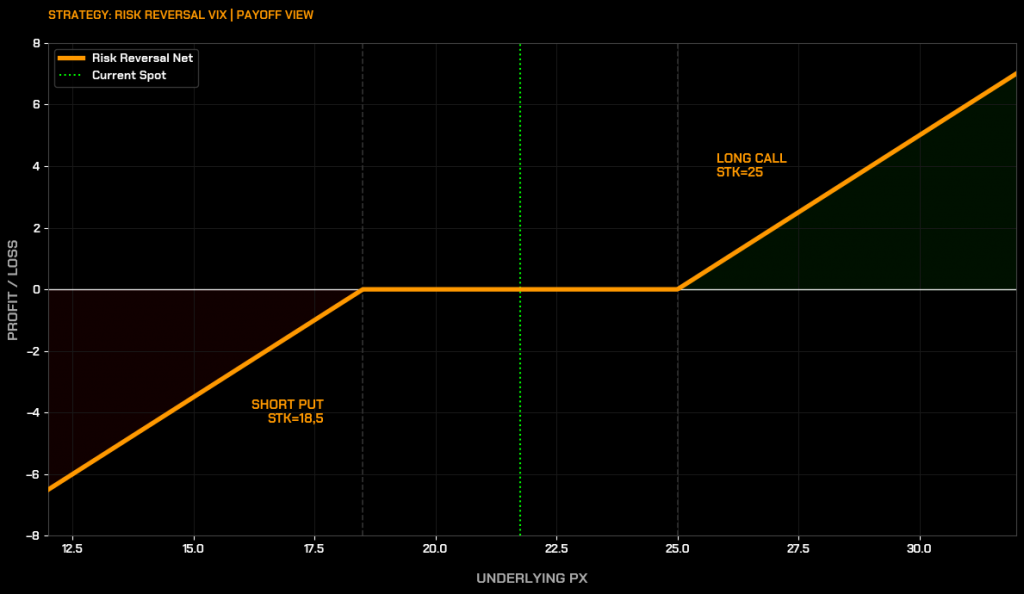
This strategy is based on a structure risk reversal, which consists of purchasing a call OTM and sell a put OTM. This combination generates a relatively neutral initial zone, allowing positioning with bullish exposure while maintaining a range margin where moderate downward movements do not aggressively affect the position.
The operation is about VIX, The S&P 500 implied volatility index, which measures the implied volatility of the S&P 500 and tends to oscillate within certain structural ranges over market cycles. I detected that one of the levels where the VIX tends to stabilize in normalized market phases, it is around 18,50, where market fluctuations position us at a key point of strategic value.
In this environment I sold a put with strike 18.50, which implies the obligation to take exposure if the VIX falls below that level. Even so, because of the market oscillations that make it constantly between these levels, unless it explodes due to uncertainty in the market, the structure remains practically neutral.
In addition, the time is playing in favor of the position, The put sold loses value through temporary erosion, which is theta decay, partially offsetting the depreciation of the call purchased and maintaining the balance of the structure.
The call OTM gives me the convexity of the strategy, which allows me to capture those sharp upward movements of the VIX. This type of behavior usually occurs in environments of market stress, macroeconomic or geopolitical events cause rapid increases in volatility, in this case, any stressful situation, in this case US-Iran war.
In times of stress, volatility tends to expand rapidly, generating explosive movements that can be captured through option structures with positive convexity and implicit leverage, I am looking for this strategy.
STRATEGIC EXPOSURE BUILDING ON NASDAQ: SYSTEMATIC PUT SELL
In addition to the risk reversal of the VIX, I also establish an opposite exposure in VIX futures. Nasdaq (NQ) by means of the systematic put selling.
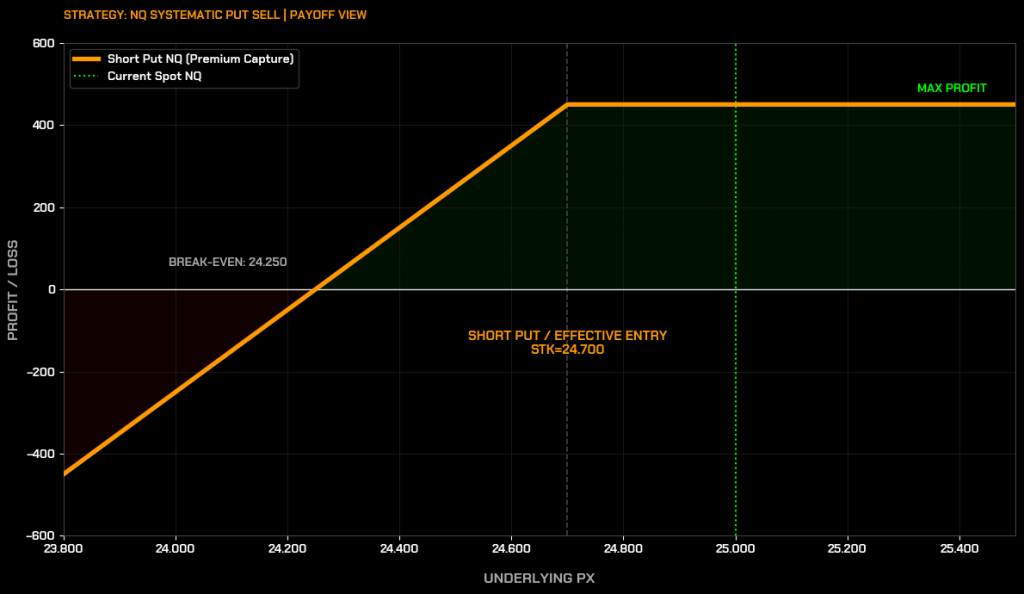
The objective of this operation is twofold. option premiums through the sale of volatility, and second, in case of allocation, to obtain an exposure to the index at a effective price below market price, which improves my average entry point.
If the options expire without being assigned, I benefit by getting the premium received from the put sold, on the other hand, if the market corrects and the assignment occurs, my long position is added another one at a more favorable level, while the premiums previously collected act as risk buffer.
Talking about the determination of points per dollar, In addition, each premium received through the sale of options increases the margin of safety of the long position. Literally these premiums act as a cushion against market downturns, The price of the exhibit is reduced by the effective price at which I purchased the exhibit.
In a simple way, the premium received is theoretically incorporated to the average price of the long position, by subtracting it from the entry level. This implies that each new premium earned reduces the average cost of the position, which widens the range of decline that the market can absorb before generating net losses.The premiums collected not only generate direct profitability, but also contribute to improving the strategy's break-even point, This increases the operating margin in the face of adverse market movements. In this way, the strategy allows me to maintain exposure to the NASDAQ with a implicit cushion generated by premiums, This improves the risk-return profile of the position.
CONVEXITY AND ACCUMULATION: STRATEGIC STRUCTURE OF POSITIONING
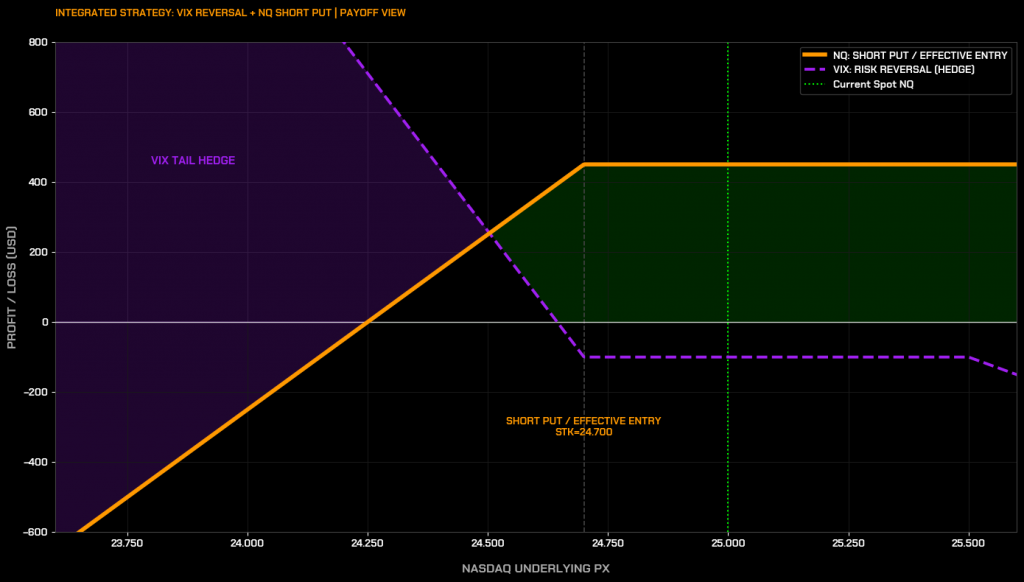
Used at the same time, the strategy allows balancing exposure to different market scenario changes. The bullish position in VIX acts as a hedge against upside breakout of volatility, The VIX tends to expand rapidly in episodes of financial stress. Taking into account the geopolitical tensions between U.S.-Iran, This behavior is even more relevant, since this type of conflict usually causes sharp increases in implied volatility in the markets.
In addition, also taking into account the fact that the market has remained for a prolonged period in a sideways range with relatively contained volatility increases the likelihood that any disruptive event will cause an abrupt expansion of volatility.
The operational operation of sale of puts on the Nasdaq (NQ) allows me to build exposure to the index at increasingly favorable effective prices, as it is constantly trading, either by capturing premiums or through allocations to lower levels.
In this way, the strategy combines fall protection with progressive accumulation of index exposure, a defensive structure in the short term, but with constructive bias in the medium term.
This allows the portfolio to be positioned with an advantage to capture the recovery when the market returns to more realistic valuation levels, relying on the historically “mean-reverting” that tend to occur during corrections in the main equity indexes.
 Spanish
  English
  German
  French