





Amper is a company undergoing a major transformation, and that means the range of possible outcomes is wider than usual. That’s why I prefer to start with the full picture rather than throw out a single figure and sweep everything that could go wrong under the rug. The base case reflects my core view and aligns with the consensus; the pessimistic scenario assumes that the integration of acquisitions stalls and that the market begins to scrutinize the quality of earnings; and the optimistic scenario reflects what happens if the multiple discount relative to the sector narrows. This is a framework of probabilities, not a specific prediction.
| Scenario | Target price | Potential | Key Assumptions |
|---|---|---|---|
| Pessimistic | 3,60 € | -25% | Teltronic’s integration is becoming more complicated, inorganic growth is slowing, and the market is beginning to penalize the quality of its earnings, as it becomes clear that a significant portion of the reported EBITDA is based on one-time expenses and subsidies. The stock would fall below its 200-session moving average and return to the levels seen at its March lows. |
| Home | 6,00 € | +25% | Base-case scenario, in line with the consensus and Renta 4’s discounted cash flow valuation. The company is on track to meet its 2026 guidance (portfolio exceeding €800 million, organic sales of €335 million, and organic EBITDA of €55 million), Teltronic is consolidating smoothly, and the group’s combined revenue exceeds €500 million for the first time. |
| Optimistic | 7,50 € | +56% | The market is narrowing the multiple gap: Amper is currently trading at around 10x EV/EBITDA, compared to an average of 16.4x for its peers. If the execution of the 2026–2028 plan gains credibility and two or three additional acquisitions are completed, the re-rating toward sector multiples, combined with EBITDA growth, justifies a significantly higher valuation. |
Reference price: €4,796 (last trading session, +4,49%). Approximate market capitalization of €435 million following the reverse stock split. Potential calculated based on this reference. Our own target prices; the base-case scenario aligns with market consensus.
In May, a private equity firm called Nazca sold a company named Teltronic to Amper. The deal closed at 155 million euros, and at first glance, there wouldn't be much to say about it. The interesting part comes next: of those 155 million, Nazca agreed to receive 44 shares of Amper, accepting them at a price 24.3% above the market price. In other words, the seller—who knew the asset inside and out better than anyone else and had every incentive in the world to take the cash and walk away—decided to remain a shareholder by paying a premium.
That's the kind of detail that makes me stop and take a closer look at a company. Because when the reported cash stays on paper instead of being withdrawn, and does so at a premium to market value, He's saying that the stock price doesn't reflect what he sees. And in Amper’s case, what had been evident for years was a label that was hard to shake: a penny stock. A company founded in 1951, with a history of expansions, restructurings, and refinancings, trading at just a few cents, with more than two billion shares outstanding and retail shareholders who bought more on a whim than based on analysis. I myself have looked into it several times in recent years and ruled it out just as many times.
It's best to start with the basics, because many people still have the image of Amper as a telecommunications company from fifteen years ago. Today's company has two distinct aspects. On the one hand, Energy and Sustainability, which accounted for 57% of 2025 sales and encompasses offshore wind platform engineering, energy storage systems, and substation remote control. On the other hand, Defense and National Security, which accounted for 43% of sales, but—and here's the important part—, EBITDA ratio (55%): 25.5 million out of a total of 46.3. In other words, the defense division generates less revenue but earns significantly more—which is exactly what you want to see in a company that is shifting its focus toward that business.
And here it’s worth highlighting a detail that the market sometimes overlooks: Along with Indra, Amper is the only company listed on the Spanish stock exchange with significant operations in the defense sector. At a time when Europe has entered a decade of structural rearmament and investors are seeking domestic exposure to military spending, being one of only two gateways is a competitive advantage that is difficult to replicate.
There is something about Amper that doesn't appear on the balance sheet and that, in my opinion, is clearly undervalued—and it has to do precisely with that long history that the market perceives as a burden. In the early 2000s, Amper participated in the implementation of the SIVE, the Integrated External Surveillance System deployed in the Strait of Gibraltar: the architecture that integrated radars and cameras to provide a unified view of the maritime border. At the time, this was a pioneering effort to integrate heterogeneous sensors into a single operational image.
Twenty-five years later, that same technical expertise is the foundation upon which Amper has built its Command and Control System for Anti-Drone Architectures (C-UAS), presented as part of the Army’s Fuerza 35 project and tested during the field trials at the Álvarez de Sotomayor Training Ground in Almería. Its executives put it bluntly: the key lies not in any specific sensor or particular jammer, but in the ability to integrate any sensor and any effector in record time, and the philosophy is a direct evolution of that of the SIVE.
I think this is important for two reasons. First, because Anti-drone defense is likely the fastest-growing segment in the entire defense industry Right now: Recent conflicts have shown that a swarm of inexpensive devices can neutralize weapons systems that cost millions. Second, because command and control is the layer where value is captured: the component that integrates the architecture remains part of the program for decades, while specific sensors and effectors are gradually replaced. Amper doesn't sell inhibitors; it sells the brain that coordinates them. And that know-how, accumulated over seventy-five years, cannot be bought or improvised.
The 2025 figures are the ones that begin to lend credibility to the story. The company ended the fiscal year with 254 million euros in sales and EBITDA of 46.3 million, up 19.61% in Q3, with a 7.2 percentage point improvement in the margin. Sales declined in absolute terms, but for a reason that I believe is positive: the effective exit from the Industrial Services business, which had low margins. On a like-for-like basis, sales rose by 1.41% in Q3, and by 14.11% in Q3 when excluding the businesses affected by the global slowdown in offshore wind.
The order backlog—the metric that really matters for this type of company—closed at 695 million euros, up 28.7%, far exceeding the target the company had set for itself. And the balance sheet improved significantly: net financial debt fell by 20% to 82.1 million, with a debt-to-EBITDA ratio of 1.8 times compared to the target of 2.99, and a cash position of 129.1 million. Much of that boost came from the 77.2 million capital increase carried out in July 2025, which was oversubscribed 4.46 times with total demand of 344 million. When a company with Amper’s reputation turns to the market for funds and receives four and a half times what it requested, something has changed in how it is perceived.

Let's return to the transaction mentioned at the beginning of the article, because it is the one that redefines the investment case. On May 7, Amper announced the Acquisition of Teltronic's 100%, the Zaragoza-based company founded in 1974 and specializing in mission-critical radio communications: private TETRA, LTE, and 5G systems for police, firefighters, emergency services, subways, high-speed railways, and critical industrial infrastructure. More than 300 engineers and deployments in some 20 countries.
The terms are important. The fixed price is 155 million euros, plus a contingent earn-out of up to 45 million and the assumption of 25 million in debt, which puts the maximum amount at around 225 million. What really interests me is the multiple: the transaction implies an enterprise value of less than nine times Teltronic's 2025 EBITDA, which exceeded 20 million. Amper is trading at less than nine times earnings, while its own comparables are trading at over sixteen. That, assuming the integration goes well, is value creation based purely on arithmetic.
Strategically, the transaction also has broader national implications. Nazca had acquired Teltronic in July 2025 from a Chinese corporation, in a deal whose stated objective was to bring back to Spain technology and industrial capabilities considered strategic. With the sale to Amper, those capabilities are now integrated into a leading Spanish company. And from a competitive standpoint, the move has implications: with Teltronic now part of its portfolio, Amper Becomes a Direct Competitor to Indra for the Ministry of Defense's Tactical Communications Contracts, a field that has been virtually monopolized until now.
On April 29, at its first Capital Markets Day, Amper presented an update to its 2026–2028 Strategic Plan. The goals are, quite simply, very ambitious: exceed 800 million euros in sales and 130 million in EBITDA by 2028, compared with 254 and 46 million in 2025. That represents a more than threefold increase in sales and a nearly threefold increase in EBITDA over three fiscal years. The order backlog is expected to exceed 1,300 million, compared with the current 695.
The breakdown is important for understanding where that growth would come from. About 620 million in sales and 90 million in EBITDA would come from organic growth of current business, and the rest 200 million in revenue and 40 million in EBITDA from inorganic growth, —that is, to make acquisitions. The company has stated that it is in negotiations with about ten companies and expects to close between three and five deals, of which Teltronic is the first and most significant. To support these efforts, the company anticipates a cumulative investment of more than 150 million between 2026 and 2028, of which 125.3 would go toward expansion-related capital expenditures.
In addition to all of the above, on July 20, Amper carried out a a reverse stock split of one new share for every twenty-five old shares, dropping from 2,276 million shares to 91 million, and from trading around 0.20 euros to trading above 4.50. From an accounting standpoint, the transaction neither creates nor destroys a single euro of value. But it has two practical implications that do matter.
The first is a matter of perception: a company that aims to generate 800 million in revenue and compete with Indra for Ministry of Defense contracts cannot continue to trade at twenty cents, because the share price shapes the narrative. The second, and more tangible, reason is that Many institutional funds are prohibited by internal policy from investing in penny stocks., no matter how good the company may be. At 0.20 euros, Amper was an uninvestable stock for a significant portion of professional investors. Above 4 euros, it is no longer uninvestable.
And here comes the part that no honest analysis of Amper can skip, because it’s the skeptics’ main argument—and, in my opinion, they’re largely right. The reported EBITDA of 46.3 million is not purely operating EBITDA. Excluding capitalized expenses (16 million in 2025, compared with 13 in 2024) and grants, Recurring EBITDA stands at 23.3 million, just 4.7% higher than the previous year. The margin fell from the reported 16.4% to a recurring 8.3%.
Added to this are the usual risks associated with a story of this nature. The execution risk is high: Integrating three to five companies over three years—while maintaining margins and without weakening the balance sheet—is difficult, and Amper's track record in integrations isn't exactly spotless. There is also risk of dilution, because part of the inorganic growth is financed by issuing shares, as has already happened with Nazca. The offshore wind sector is experiencing a global slowdown, and the company itself does not expect demand to rebound until 2027. Finally, it is a small-cap, illiquid stock with a largely retail shareholder base, which amplifies price movements in both directions.
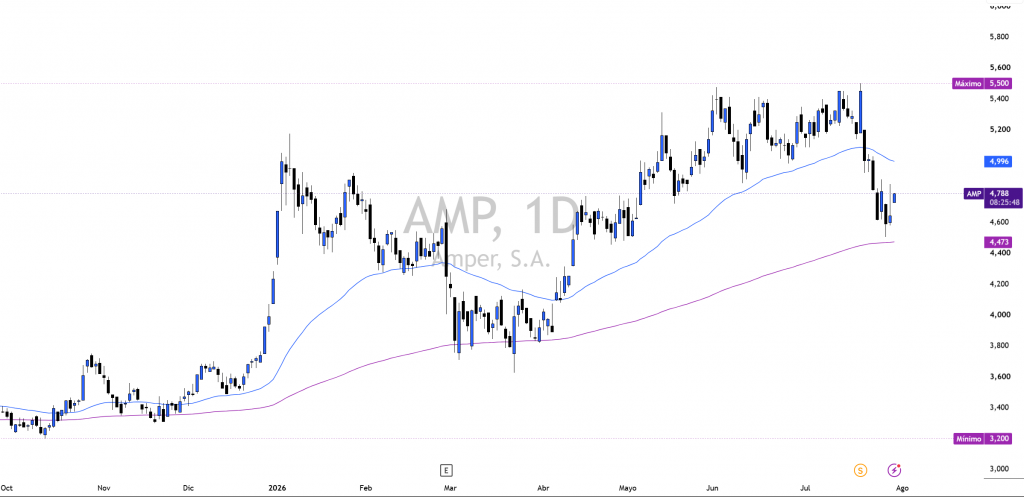
The daily chart aligns quite well with the fundamental thesis, and it’s important to interpret it with a few caveats in mind: the reference points have been adjusted for the reverse stock split, so the historical levels appear multiplied by twenty-five compared to what many investors have in mind.
The trend over the past twelve months is clearly bullish. The stock started from a base around the 3.30–3.40 euros in October 2025, saw an initial surge to nearly 5.20 in early 2026, then corrected to the 3.70 range in March, and from there built a second, much more orderly uptrend that led it to reach peaks in the range of 5.45–5.50 in June. The key point is that each correction has resulted in higher lows, which is the very definition of a healthy uptrend.
The July correction was the litmus test. From those June highs, the stock fell to 4.58 euros, a decline close to 16%, and found support just above the 200-session moving average, which stands at 4,368 and continues to rise steadily. A price correction that finds support at a rising long-term moving average is, technically speaking, the best-case scenario. In the last trading session, the stock rallied strongly, opening at 4.60, hitting a low of 4.58, and closing at 4,796, up 4,49%, very close to the day's highs.
The level map is therefore quite uncluttered. At the top, the first notable landmark is in the area of the 5.23 euros, and a breakout above that level on strong volume would pave the way toward the yearly highs of 5.50 and, from there, toward my base-case scenario of 6 euros. On the downside, The 200-session moving average at 4.37 is the level that should not be breached: As long as the price remains above this level, the bullish trend remains intact. A break below this level accompanied by high volume would be the first serious warning sign.
The market consensus puts the average 12-month price target at 5.97 euros, with an upper estimate of 6.25. Renta 4, through its analyst Iván San Félix, maintains an “overweight” recommendation with a price target that, adjusted for the reverse stock split, is exactly equal to 6.00 euros per share, using discounted cash flow analysis for the 2026–2030 period and—this is important—, excluding the potential impact of corporate transactions pending.
I set my target price at 6 euros, in line with that consensus, which, based on current levels, implies a potential of close to 25%. I base this on three pillars: first, the conversion of the record-high order backlog into revenue, with 55% of the year’s revenue already secured as of March; second, the consolidation of Teltronic, acquired at less than nine times EBITDA; and third, the valuation spread — Amper is trading at about 10 times EV/EBITDA, compared with an average of 16.4 times for its peers.
The upcoming catalysts are specific and have set dates. The First-half results, scheduled for September 8, will be the first real test of the guidance and of how Teltronic is beginning to consolidate its position. The announcement of the second and third acquisitions under the plan would be the next catalyst—the consensus does not factor them in. The progress of the Army’s C-UAS program within the Fuerza 35 project could lead to contracts whose value is not currently reflected in the stock price. And in the background, the European defense spending cycle.
Adjust the probability you would assign to each scenario and check the price and the weighted expected return. This is a tool for reflection, not a prediction.
Default weightings (25% / 50% / 25%) are provided for illustrative purposes only. The calculation is linear: expected price = Σ (probability × target price for the scenario). This is not a substitute for financial advice.
I'll summarize the thesis as I see it. I'm looking at a company that It has gone from being a penny stock to a defensive small-cap company with its own technology, which trades at a discount of approximately one-third compared to its peers, and which has just acquired an industrial gem in the critical communications sector at less than nine times EBITDA—a deal in which the seller chose to remain a shareholder by paying a 24% premium rather than receiving cash, and which possesses, in the field of anti-drone command and control, a legacy of seventy-five years of expertise that no competitor can replicate. All of this with half the year’s revenue already booked in March, a balance sheet showing debt at 1.8 times EBITDA, and a share price supported by a rising 200-session moving average.
To be honest—and I make no secret of it—I face a situation where the quality of our results is debatable, with half of our EBITDA coming from one-time projects; a growth plan that calls for tripling sales in three years and acquiring several companies without making any mistakes; and a corporate track record that calls for caution. That is exactly why the discount exists, and as a result, my pessimistic scenario anticipates a decline of 25%.
And there's a time-related nuance that I particularly like: much of what could drive this initiative doesn't depend on a slow, ten-year rollout, but rather on verifiable milestones over the next twelve to eighteen months, starting with the September results. The fact that Amper is no longer quoted in cents does not automatically make it a good investment, and anyone who buys it expecting the same old penny stock is going to get a shock at some point. But for the first time in a long time, the financials back up the story, and that forces us to look at it with fresh eyes. I’ll be commenting on how this thesis unfolds as the described catalysts are—or aren’t—met.
 Spanish
  English
  German
  French