





As we enter the Spanish market—which is not our primary focus, although we always keep an eye out for potential opportunities—, Grenergy Renovables S.A. ($GREG) It presents itself as a company with a structural growth profile and international expansion.
Grenergy develops solar energy and BESS storage projects and is undergoing a phase of rapid expansion with a portfolio of 71 GWh of storage and 12 GW of solar capacity at various stages of development and with an active presence in Europe, Latin America, and the United States. Its asset rotation model and high level of capital expenditures, 3.7 billion EUR committed through 2028, positioning it as one of the most significant renewable energy mid-cap companies in Europe.
Here is a table with the current price and estimated valuation scenarios, where I, Diego García del Río, I set them based on medium- to long-term operational and financial potential:
| GREG | CURRENT | PESSIMISTIC | NORMAL | OPTIMIST |
| PRICE | 76.60 EUR | 70 EUR | 110 EUR | 120 EUR |
| UPSIDE | - | -8,62% | +43,60% | +56,66% |
*The target prices are based on EBITDA projections, pipeline expansion, potential inclusion in the IBEX 35, and growth in the BESS segment, with upward adjustments in the event of new asset rotations or international storage agreements. This analysis examines Grenergy’s immediate catalysts, key fundamentals, and technical outlook, with a focus on opportunities for structural appreciation within the European energy market.
Grenergy Renovables SA (GREG)
It is interesting to note that this Spanish company specializes in the development, construction, and operation of renewable energy projects, primarily in solar photovoltaics and battery storage. The company operates in Europe, Latin America, and the United States, and shows Rising revenue driven by asset turnover and a strong position in energy storage, even so, it features a high level of debt and operational risks related to the implementation of large-scale projects.
Founded in 2007, headquartered in Madrid, and publicly traded since 2015, the company is currently experiencing a period of rapid expansion. In 2025, it closed its first fiscal year with revenue exceeding one billion euros: 1,069.9 million EUR in revenue (+661 TP3T), EBITDA of 201.4 million EUR (+261 in Q3) y 87 million euros in net income (+46%)with a CAPEX of 880 million EUR (+361 TP3T). In that same fiscal year, it built nearly 1 GW of solar power and 7 GWh of storage, and at the end of the first quarter of 2026, it reported 2.2 GW of solar capacity and 8.6 GWh of battery storage in operation and under construction, after having completed 1.3 GW and 8 GWh over the past 18 months. The company has a workforce of approximately 640 people.
The downside lies in the balance sheet and the volatility of earnings. Net debt stood at 993M EUR at the end of 2025, with a leverage ratio of 5x EBITDA; gross debt reached 1,064.5M EUR, 428.9M more than in 2024. And the start of 2026 was weak precisely because of the lack of inventory turnover during the quarter: Q1 2026 revenue fell to 143 million EUR (compared to 237M in Q1 2025), EBITDA plummeted to 5 million EUR (62M in Q1 2025) and net income came in at 2 million EUR (32M a year earlier). Cash stood at 429M EUR, with total leverage at the end of the quarter at 8.1x (2.5x at the corporate level) and pro forma leverage at 2.4x (0.4x at the corporate level). This is the structural risk of this model: Profit depends on when asset sales are closed, not on a stable recurring cash flow, and that makes any isolated quarterly reading unrepresentative.
Industry Positioning and Plan Through 2028
Taking the sector into account, Grenergy Renovables S.A. (GREG) It is a mid-sized company in the renewable IPP segment in Europe and Latin America, with a market capitalization of approximately 2,160M EUR, compared to competitors such as Solaria Energía y Medio Ambiente (~2,100M EUR) or Audax Renovables (~530M EUR). The stock has experienced an extraordinarily volatile year, with a 52-week range between 60.3 and 136.6 EUR, which gives an idea of how sensitive the share price is to project milestones and asset sales.
Where Grenergy One area where it stands out from its peers is in its storage pipeline: 71 GWh of BESS projects, of which about 9 GWh are already in an advanced stage of development. In May 2026, the company increased its investment plan to 3,700 million EUR for the 2026–2028 period, approximately 1,500M EUR more than previously anticipated, with financing broken down as follows: 2,800M in project finance, 200M in corporate debt, and 800M from asset rotation, with an approximate geographic breakdown of 45% in Europe, 45% in Chile, and the remainder in the United States.
The goal for 2028 is to reach 5 GW of solar power and 22 GWh of storage in operation and under construction: 2.5 GW plus 14.1 GWh in Chile, 1.4 GW plus 5.1 GWh in Europe, and 1 GW plus 3.2 GWh in the United States. The new component of the plan is Iberian Oasis (1 GW of solar power + 3.2 GWh), which brings the hybrid model—already tested in Chile—to the Iberian market.
As for recent performance, milestones have been accumulating, and asset turnover now exceeds the 60% of the projected target, with Phases 1 through 4 of Oasis de Atacama (723 MW and 3.64 GWh) sold for approximately 1,500M USD; Phase 6 of the project, Elena, was commissioned in June 2026 with a nominal installed capacity of 3.5 GWh and plans to expand to 7 GWh; in the United States, the company signed a hybrid PPA for Beaver Creek (229 MWp + 183 MWh) with Georgia Power for 400 GWh annually over 20 years; In Spain, Escuderos obtained permits and financial tolling for its 680 MWh of batteries, with operations scheduled to begin in the first half of 2027, while Oviedo (600 MWh) secured 100M EUR in financing in July 2026. In addition, that same month, a EUR 200 million green promissory note program was registered.
All of this puts Grenergy as a major player with a competitive edge in a booming storage market, albeit one with a clearly demanding profile: The plan through 2028 nearly doubles current capacity and is based on an investment of 3,700M EUR, high leverage, and the ability to continue selling mature assets at attractive multiples. The track record The results from the past 18 months work in their favor; the margin for error, however, is narrow.
$GREG: Fundamental Analysis — Accelerated Growth with a Challenging Balance Sheet
Grenergy Renovables SA (GREG) is currently experiencing rapid growth in revenue and profitability, driven by asset turnover and expansion into markets such as Chile and Spain, against the backdrop of a challenging financial structure. With a market capitalization of approximately 2,160M EUR, the company ranks as a mid-sized player in the independent renewable power producer (IPP) segment, surpassing industry peers such as Audax Renovables (~530M EUR) in terms of operational scale and geographic diversification, and has already moved ahead of Solaria Energía (~2,100M EUR), which it has surpassed in market capitalization over the past year. Its focus on photovoltaic and battery storage projects generates revenue through three channels: energy sales, operation and maintenance services, and the sale of developed projects, with a global portfolio of 71 GWh of storage and 12 GW of solar capacity under development, supporting projections for sustained expansion.
Valuation: Expensive based on multiples, cheap based on consensus targets
GREG's valuation metrics currently show a significant premium relative to its peers. Based on 2025 earnings (87M EUR, equivalent to a EPS of about 3.10 EUR), the stock is trading at a P/E ratio close to 28x. The EV/EBITDA stands at around 17x With 2025 EBITDA (201.4 million EUR) and net debt of 993 million EUR, this is a demanding multiple that only makes sense if one assumes that EBITDA will multiply once the battery portfolio begins operations around 2028. With shareholders’ equity of just 390.6M EUR compared to 2,290M EUR in total assets, the The price-to-book ratio is around 6x, well above the industry average.
To be honest, based on historical multiples, GREG isn't cheap. The only thing supporting the bullish case is future growth. And the analyst consensus is buying into it; the The average 12-month price target is around 131 EUR, with a range between 79.5 and 155 EUR, implying a potential gain of nearly 37% from the current share price. That range—with the low and high ends nearly doubling each other—is in itself the best summary of the case: there is no real consensus on how much this company is worth, but rather that its value depends entirely on execution.
Shareholder Returns
GREG currently does not pay dividends, in line with most of its growth-oriented peers and below the sector average, prioritizing reinvestment in capital expenditures. It has, however, engaged in share buybacks; in 2025, it completed a program representing 2,44% of its share capital, with an investment of 27M EUR at an average price of 37.7 EUR per share, A transaction that, given the current share price of over 95 EUR, proved very favorable for shareholders.
Summary: The Weak Point
Debt is the main weakness of the argument. The Net debt at the end of 2025 stood at 993 million EUR, with a total leverage ratio of 5x EBITDA, which the company reduces to 1.5x on a pro forma basis by incorporating the asset disposals already agreed upon. Gross debt totaled 1,064.5M EUR, 428.9M more than in 2024. In contrast, shareholders’ equity stands at 390.6M EUR against total assets of 2,290M EUR and total liabilities of 1,900M EUR, with a cash position of 373M EUR at year-end (EUR 429 million at the end of Q1 2026) and an interest coverage ratio of approximately 3.9x.
It's a tense situation, and I'm saying this without sugarcoating it, The debt-to-equity ratio exceeds 350%. The company manages this using two tools: non-recourse project financing, which isolates a significant portion of the risk within each asset’s vehicle, and the ongoing sale of mature assets; however, both depend on the secondary market for renewables continuing to absorb projects at attractive valuations. In 2025, the company recorded sales of nearly 1,000M USD in enterprise value (about 850M EUR), exceeding the 60% turnover target for the 2025–2027 period, with the first four phases of Oasis de Atacama sold for approximately 1,500M USD, the 88 MW photovoltaic project in Colombia, and the José Cabrera and Tabernas projects (297 MW) in Spain sold for 273M EUR.
Growth: The Strongest Argument
GREG's strong performance in growth metrics is hard to dispute. Revenue rose from 400M EUR in 2023 to 643M in 2024, and 1,069.9 million EUR in 2025 (+66%), having nearly tripled over two fiscal years. EBITDA grew by 26% to 201.4 million EUR, and net income rose by 46% to 87 million EUR. CAPEX reached 880 million EUR (+36%), and the investment plan has increased to 3,700 million EUR for 2026–2028, compared to 3,500M in the previous plan.
Now then, That growth is neither linear nor recurring, and the first quarter of 2026 made that clear, with no inventory write-downs during the period, revenue fell to 143M EUR (from 237M), EBITDA to 5M EUR (from 62M), and net income to 2M EUR (from 32M). CAPEX for the quarter was 132.5 million EUR. Anyone investing in GREG should expect that quarterly results will be irregular due to the nature of the business model, and should evaluate the company based on 12- to 18-month cycles, not on quarter-over-quarter comparisons.
Profitability
Margins in 2025 were strong for the sector, EBITDA margin of 18.81% in Q3 y net margin of 8.11% in Q3, with EBIT of about 180 million EUR. The ROE stands at around 22%, a high figure that should be interpreted with caution, is inflated by a low net worth relative to the size of the balance sheet; in other words, it reflects both efficiency and leverage. The ROA, which is more revealing, is around 3.8%.
An important point to understand where the profit—the EBITDA—of the energy business comes from, the truly recurring part, was about 50 million EUR in 2025, barely a quarter of total EBITDA. The rest comes from the development, construction, and sale of assets. That is the difference between GREG and a traditional utility, and it is the reason why its multiples are not directly comparable to those of a pure-play IPP. Today, it is, to a large extent, an industrial developer that also operates assets, and the transition toward a more recurring revenue profile depends precisely on the battery portfolio coming online as planned.

$GREG: Key Catalysts, Sector Momentum, and Price Scenarios
Regarding the upside potential of Grenergy Renovables SA (GREG), I would like to highlight three key factors that support it:, and at the same time put a strain on The thesis: The gap between analyst consensus and the stock price, the sectoral cycle in the storage industry, and a series of already-confirmed operational catalysts versus those that are purely speculative.
The play resulted in its all-time high on May 27, 2026, at 136.60 EUR, and It is trading today at around 95.90 EUR, 30% below its highs, with a 52-week range between 60.30 and 136.60 EUR. We are therefore not looking at a stock in a clear uptrend, but rather one that has corrected sharply following an extraordinary rally. This is the necessary starting point for any analysis of its potential.
Analyst Ratings and Recommendations
The consensus of 10 analysts puts the average price target at 131.15 EUR, ranging from 79.5 EUR to 155 EUR, which implies a Estimated upside of +37% from current levels (~95 EUR), driven primarily by forecasts of revenue growth and EBITDA expansion.
All of the firms covering the stock maintain a “buy” recommendation, citing exposure to structural growth in the renewable energy sector, the recovery of PPAs, declining storage costs, and the favorable macroeconomic environment following the stabilization of interest rates in Europe. In my view, the stock could consolidate between 95 and 105 EUR in the short term, and exceed 120 EUR if new projects are confirmed or if the company's inclusion in the IBEX 35 is announced, a catalyst with a direct technical impact on institutional demand.
Sector Momentum and Structural Factors
The global renewable energy sector is experiencing a new surge of momentum. The Spain's PNIEC projects a +34% increase in electricity demand by 2030, while energy consumption by data centers could double over the same time frame, driven by the expansion of AI and industrial electrification. Clean energy indices continue to perform well, which is fueling investor interest in companies with strong pipelines such as Grenergy, whose portfolio includes 71 GWh of storage and 12 GW of solar capacity at various stages of development. The steady decline in storage costs and lower interest rates create an optimal financial environment for expanding their pipeline and optimizing BESS (battery energy storage systems). These structural conditions place GREG in a prime position to sustain organic growth, taking advantage of European incentives, although the substitution effect resulting from the closure of nuclear plants in Spain remains uncertain following the Nuclear Safety Council's favorable ruling on the Extension of the Almaraz plant until 2030, now awaiting the government's decision.
Operational and Speculative Catalysts
Among the already confirmed catalysts, two milestones in June 2026 stand out: the inauguration of Elena, the largest battery plant in the Americas, in Antofagasta, and the signing of the largest PPA by volume in the company’s history—a contract to supply 1 TWh annually for 15 years during non-solar hours to a global utility with an investment-grade rating, effective between July and October 2026.
In terms of forecasts, the consensus projects annual growth of +24% in EPS and +6% in revenue, with capacity expansion toward 5 GW of solar power and 22 GWh of storage in operation and under construction by 2028, up from the current 2.2 GW and 8.6 GWh. Asset rotation—such as the sale of the first phases of Oasis de Atacama—frees up liquidity for reinvestment and validates the portfolio’s valuations, although reduces recurring EBITDA when the asset is removed from the scope of consolidation.
There are three current speculations that could trigger a higher target price:
- Inclusion in the IBEX 35, with a potential impact in the short term, although this is constrained by a free float of approximately 28%—which the Technical Advisory Committee’s regulations expressly penalize—and by an index whose composition has remained unchanged for two years.
- Partnerships in Storage, with rumors of joint ventures in Chile and Europe that could accelerate the contribution to EBITDA by 2027.
- Additional Green Financing, including the EUR 200 million green note program registered in July 2026, intended to finance the organic investment plan.
These combined factors reinforce a structurally bullish outlook for Grenergy; its profile combines tangible growth, efficient international expansion, and a high leverage (5x EBITDA) which requires discipline in its implementation.
$GREG: Revaluation Scenarios
In a optimistic scenario (2026+), with the full implementation of the solar and BESS pipeline, the continued rotation of strategic assets such as Oasis de Atacama, and the possible inclusion in the IBEX 35, the target price would be around 120 EUR, implying an upside of 56.66%, this scenario assumes annual EBITDA growth exceeding 20%, a low-interest-rate environment, and progress on storage joint ventures in Chile and Europe, which will increase project profitability and strengthen the operating margin.
In a normal situation, the company would maintain a steady pace of organic growth, moving toward the 5 GW of solar capacity and 22 GWh of storage projected for 2028, with gradual expansion of cash flow and periodic asset rotations; within this framework, the target price would be 110 EUR, reflecting an upside of 43.60% above current levels, supported by the normalization of financing costs and the continuation of pro-renewable energy policies in the EU. In contrast, in a pessimistic scenario, a slowdown in the integration of BESS projects, regulatory delays, or declines in PPA prices could limit the upside, setting the target price at around 70 EUR, equivalent to a downside of 8.62%. Even so, the sectoral outlook would remain favorable due to the energy transition and the structural upturn in electricity demand, providing Grenergy with crucial support even in an adverse environment.
$GREG: Technical Analysis — Corrective Structure and Rebound Signals
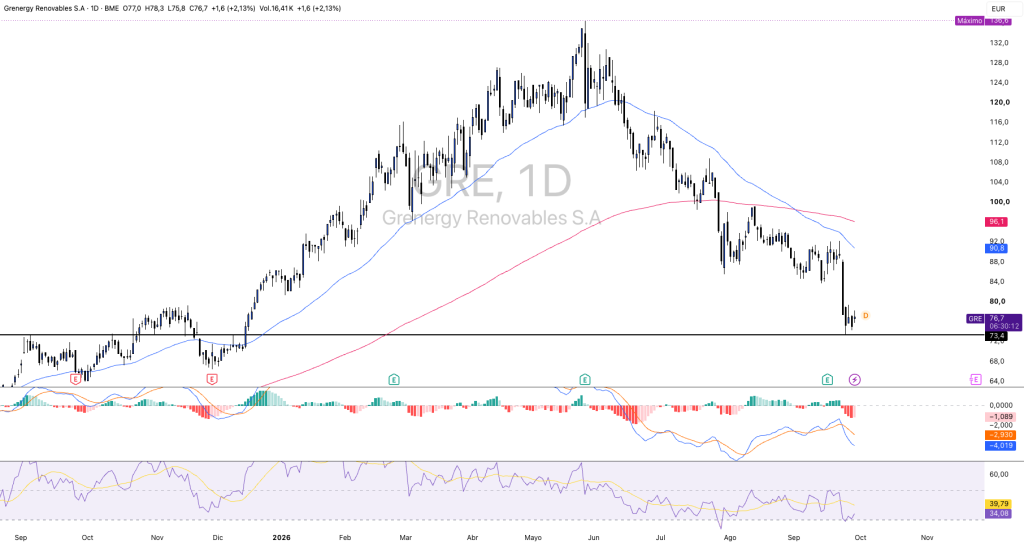
Right now Grenergy Renovables S.A. ($GRE) maintains a A clearly bearish pattern on the daily chart, after setting its all-time high in 136.60 EUR in late May. From that level, the price has fallen by approximately one 44%, currently standing at 76.70 EUR. The technical decline has accelerated in recent trading sessions following the break below the consolidation zone of 86–90 EUR, creating a new lower low and driving the price directly toward the relevant support level located at 73.40 EUR, which is a historic reaction level.
The price is quoted well below its two medium- and long-term benchmarks, the exponential moving average (EMA 50) is approximately at 90.80 EUR and continues to trend downward, while the slow moving average is around 96.10 EUR and is also starting to trend downward. Furthermore, the fast moving average is already below the slow one, reinforcing the bearish pattern. As long as the price remains below 90.8–96.1 EUR, there is still no technical signal of a trend reversal, only the possibility of rebounds within a downtrend.
Momentum indicators also do not yet show a clear sign of a turnaround. The The RSI is at 34.08, below its average, which is approximately 39,79, and very close to the 30 oversold threshold. This reflects high selling pressure and raises the possibility of a technical rebound due to exhaustion, but still There is no divergence or rebound from the 50 level to confirm buying strength.. The The MACD remains clearly negative, with the MACD line at approximately −4.02, below its signal, which is around −2.93, while the histogram widens again on the negative side to approximately −1.09. Therefore, momentum currently confirms the downward acceleration observed in the price.
In terms of technical levels, the most important reference point is now at 73.40 EUR, an area that coincides with a previous significant price level and is currently being tested following the recent sharp decline. Holding this level would be important in an effort to establish a short-term floor. If the 73.40 EUR If they were consistently broken, the chart would technically be exposed to the area of 68–70 EUR and then toward 64 EUR, where the following visible reference points appear. At the top, the first resistance level is now located in the former support zone of 84–88 EUR; then come 90.80 EUR (fast average) y 96.10 EUR (slow moving average). A recovery in this last area would be necessary to begin seriously challenging the current downtrend.
GRE is currently in a bear market. We are no longer simply facing a correction from record highs; the loss of the 85–86 EUR, accompanied by a new lower low and the simultaneous deterioration of the RSI and MACD, confirms a further extension of the downward trend. The key level in the very short term is 73.40 EUR. As long as it manages to stay above this level, a technical rebound could occur, especially given that the RSI is nearing oversold territory; but to speak of a structural improvement, it would first have to recover 86–88 EUR, then 90.80 EUR and, above all, the area of 96 EUR. A clear loss of 73.40 EUR, on the other hand, would keep the downward correction open toward lower levels.
 Spanish
  English
  German
  French